


How to Preserve Family Photos in Laguna Woods: A Step-by-Step Guide
What if the most valuable assets in your home aren't the ones listed on an insurance policy, but the fading 35mm slides and brittle albums tucked away in a closet? For many residents, the desire to preserve family photos in Laguna Woods is often met with the daunting reality of aging paper and confusing technical specs. You've likely felt that familiar pang of worry when looking at a yellowing wedding portrait or a dusty box of 8mm film. It's a heavy burden to carry when you realize these irreplaceable moments are vulnerable to time, heat, and humidity.
We understand that these aren't just images; they're your family's unique legacy. You want a way to protect them without the stress of complicated equipment or the fear of losing the originals. This guide provides a clear, professional path to digitizing your collection. You'll learn how to transform physical media into a high-resolution digital library that's easy to share and impossible to lose. We'll cover everything from organizing your archives to selecting the right preservation methods, ensuring your history remains vibrant for generations to come.
Key Takeaways
- Learn why the South Orange County climate poses a unique risk to physical media and how stabilization stops further decay.
- Discover the most efficient ways to categorize prints, 35mm slides, and negatives to simplify your future digital library.
- Compare the quality of consumer scanners against professional archival equipment to determine the best approach for your collection.
- Find the safest way to preserve family photos Laguna Woods by leveraging local expertise instead of risking your originals in the mail.
- Understand the specialized steps used in individual photo scanning to ensure every image is captured with professional precision.
The Critical Need to Preserve Family Photos in Laguna Woods Today
Photo preservation is more than just a technical task; it's an act of stewardship. It involves the careful stabilization of physical media followed by high-resolution digitization. To effectively preserve family photos Laguna Woods families need to understand that their collections are currently under threat from the very environment they live in. While the Southern California lifestyle is enviable, the specific climate of South Orange County can be a silent enemy to heirloom prints and slides. Preservation creates a bridge between the fragile past and a secure digital future.
The goal is to stop active decay before it's too late. When we talk about preservation, we aren't just making a copy. We're ensuring that the original story survives. This process is essential for anyone who wants to pass down a clear, vibrant history to their children and grandchildren. Without intervention, the chemical reality of old film and paper means these memories will eventually disappear. You don't have to let that happen.
Environmental Threats to Local Media
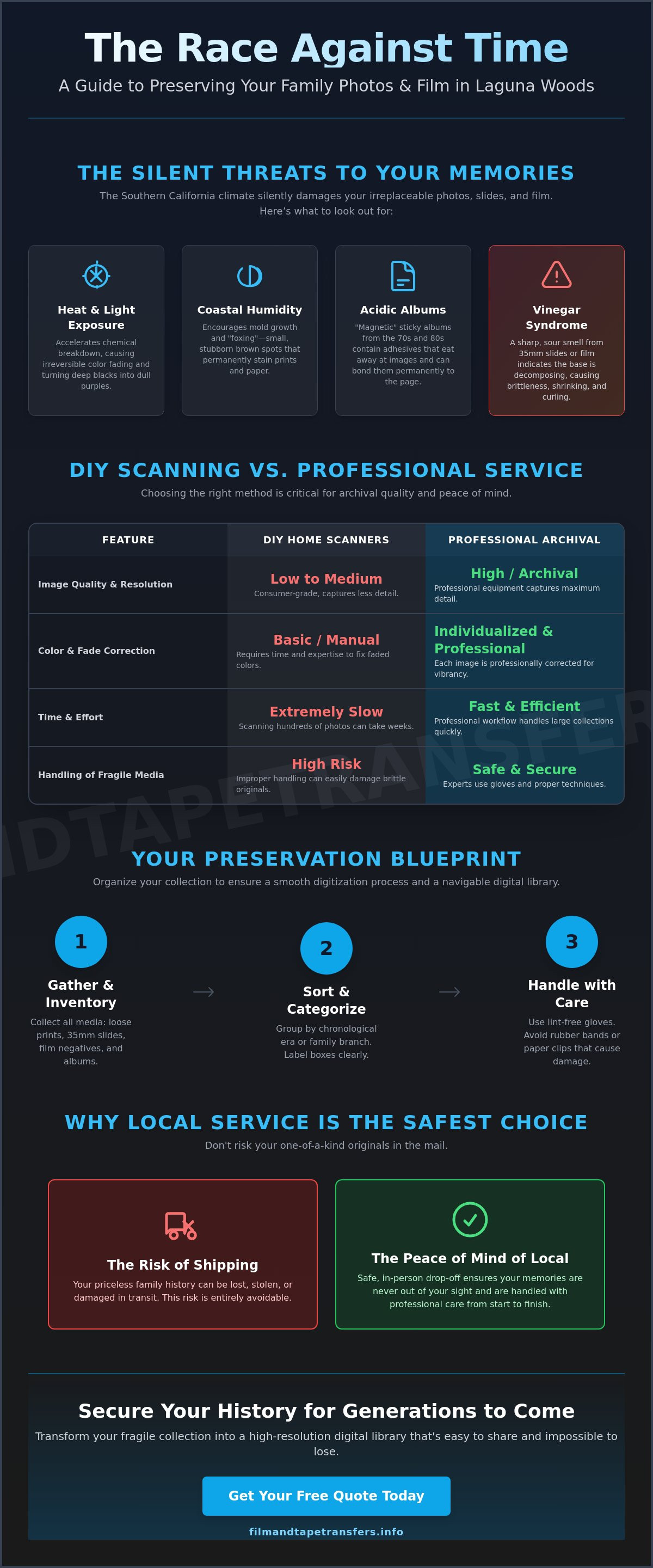
Many residents store their life's history in garages or outdoor storage units. These spaces are subject to significant temperature swings that destroy photo emulsions. Heat accelerates chemical breakdown, while coastal humidity encourages the growth of mold and foxing. These are those small, stubborn brown spots you often see on old paper. Even framed portraits on your walls face risks. Constant exposure to light causes irreversible fading, turning deep blacks into dull purples. Physical albums, once thought to be protective, often contain acidic adhesives that eat away at images over decades. In 2026, a physical-only storage plan is no longer a safe strategy.
Understanding Media Decay and Vinegar Syndrome
If you open a box of old 35mm slides and notice a sharp, sour scent, you're smelling Vinegar Syndrome. This is a specific form of chemical decay that affects acetate film bases. It signals that the film is literally decomposing. As the process continues, the slides become brittle, shrink, and eventually curl into tight rolls that are impossible to scan. Faded colors in your prints are another warning sign. These shifts indicate that the chemical bonds in the original ink are failing. This is a vital stage in the conservation and restoration of photographs where professional intervention is required. Digitizing these items now captures the image before the physical medium becomes too brittle to handle.
Acting today ensures your local legacy doesn't vanish. By converting these fragile items into high-resolution files, you secure the image forever. It makes your history portable and easy to share across generations. A digital library is much easier for the next generation to cherish than a heavy, decaying box in a closet. To preserve family photos Laguna Woods residents should prioritize these "ticking clock" items like slides and vintage prints before the damage becomes permanent.
How to Organize Your Family Collection for Digitization
Starting your project begins with a complete inventory. You need to gather every media type in your possession. This includes loose prints, 35mm slides, and film negatives. Organizing these items before you begin to preserve family photos Laguna Woods residents often find that a structured approach reduces stress. Instead of scanning randomly, sort your collection by chronological era or specific family branches. This preparation ensures your future digital library is easy to navigate and share with relatives.
Pay close attention to "magnetic" sticky albums from the 1970s and 80s. The adhesive on these pages contains chemicals that can permanently bond to the backing of your photos. Carefully peel them back. If they are stuck, set them aside for professional care rather than forcing them. Label every box and envelope clearly. If your physical containers are organized, your digital folders will mirror that order. This makes it simple to find a specific holiday photo years from now.
Safe Handling and Preparation Basics
Proper handling protects your originals from further damage. I recommend using lint-free cotton gloves when touching negatives or slides. Your skin's natural oils can leave permanent prints that obscure detail during the scanning process. Avoid using paper clips or rubber bands. These items degrade over time, leaving rust marks or sticky residue on your memories. For the best results, consult the Library of Congress guide to photo care for professional storage standards. Before scanning, use a soft blower brush to lightly dust slides. This step prevents small particles from appearing as large blemishes in your high-resolution files.
Prioritizing Your Preservation Project
Large collections can feel like a burden. Break the work into manageable batches to stay motivated. Focus first on "Tier 1" memories. These are your most significant life events, such as weddings, births, and unique historical moments. Because of the chemical decay risks discussed earlier, 35mm slides should be high on your list. Their colors shift faster than modern prints. If you find yourself overwhelmed by the sheer volume of media, consider a professional photo scanning service to handle the heavy lifting. This allows you to focus on the storytelling while experts manage the technical preservation. Set aside any items that are torn, water-damaged, or stuck together. These require specialized handling to prevent further loss.
DIY Scanning vs. Professional Services: Making the Right Choice
Deciding how to digitize your collection often comes down to a choice between personal time and professional quality. Many residents consider purchasing a home scanner to preserve family photos Laguna Woods. While this seems cost-effective, the reality of DIY scanning involves a significant learning curve and a massive time commitment. A single box of 500 slides can easily consume 40 to 60 hours of labor when you account for cleaning, scanning, and basic file naming.
Professional equipment operates on a different level than consumer flatbed scanners. Most home devices rely on software interpolation to "upscale" images, which often results in pixelated or soft details. Professional-grade archival scanners capture the true optical resolution of the film or print. This ensures that your digital files have enough detail for large-scale printing or viewing on modern 4K screens. When you choose a professional path, you're investing in the longevity and clarity of your family's history.
The Reality of Home Scanning Equipment
Cheap, portable slide scanners are widely available online, but they often produce disappointing results. These devices typically use a small camera sensor rather than a true line scanner. This leads to poor dynamic range, where details in the dark shadows or bright highlights of an old photo are lost forever. Additionally, the hidden costs of DIY include the price of high-end software and the ongoing maintenance of the hardware. Without professional calibration, your scans may end up with a consistent color cast that is difficult to fix later.
Benefits of Archival-Grade Professional Digitization
Expert services provide more than just a scan; they offer a complete restoration workflow. Utilizing a specialized 35mm slide scanning service ensures your images benefit from Digital ICE technology. This infrared-based process identifies and removes physical scratches, fingerprints, and dust particles without affecting the actual image data. It saves hours of manual retouching while producing a clean, sharp result.
The final delivery format is equally important for long-term stability. Professionals typically offer files in uncompressed TIFF formats for archival purposes or high-quality JPEGs for easy sharing. These files are color-corrected to counteract the fading and chemical shifts mentioned in previous sections. When you preserve family photos Laguna Woods through an expert service, you receive an organized digital library that is ready for the future. The cost-to-quality ratio favors professional work when the items being handled are truly irreplaceable heirlooms.
Local Preservation Steps for Laguna Woods Residents
Laguna Woods residents have access to excellent community resources that make the archiving process easier. Organizations like the Laguna Woods Camera Club offer a space for neighbors to share advice on historical projects. While community groups are great for inspiration, the actual technical work requires a steady, professional hand. Choosing a local specialist is the most secure way to preserve family photos Laguna Woods families have held for generations. Local service means your irreplaceable originals never enter a high-volume shipping system.
Hand-delivering your media creates a layer of personal accountability that mail-in services cannot match. You can walk into a facility and see exactly where your memories will be handled. This direct connection provides peace of mind. It also allows for a clear discussion about your specific goals. Whether you have a single box of wedding photos or a massive archive of 35mm slides, local expertise ensures your project receives the attention it deserves.
Why Local Service Matters for South OC Families
Shipping irreplaceable memories across the country often leads to "lost in the mail" anxiety. Big-box mail-in services process thousands of orders daily, which can feel impersonal. Using a local service in South Orange County eliminates this risk entirely. You get the benefit of speaking directly to the technician who will perform the work. These experts understand the local history and the weight of the materials they handle. Supporting local businesses also ensures that high-quality preservation services remain available in our community.
Preparing for Your Digitization Appointment
Once your collection is sorted, pack your media securely for transport. Use sturdy, plastic bins or flat-bottomed boxes to prevent items from shifting in your vehicle. Avoid using flimsy bags that could allow photos to bend or slides to spill. When you arrive at your appointment, ask your technician about their specific scanning resolution and the equipment they use. It's also helpful to understand the turnaround times for bulk projects. While every collection is unique, most local specialists can provide a reliable timeline based on the volume of media you bring in.
After the digitization is complete, you'll need to select a delivery format. Most residents prefer high-capacity USB drives or secure cloud storage for easy sharing. External hard drives are also a great option for very large collections involving film and video transfers. These digital formats ensure your family history is portable and protected against future physical loss. If you are ready to secure your legacy, contact an expert in photo scanning in Laguna Woods to begin your preservation journey.
Trusting Film and Tape Transfers with Your Family Legacy
With over 30 years of experience in archival media preservation, we understand the weight of the materials we handle. To preserve family photos Laguna Woods residents need a partner who values precision over volume. We don't use automated batch processing that ignores the unique needs of each image. Instead, our team scans every photo and slide individually. This meticulous approach ensures that the clarity and color of your original media are captured with absolute fidelity. We treat your collection with the same care we would use for our own family history.
Our commitment to the South OC community is rooted in a shared history. We've spent decades helping neighbors secure their legacies against the environmental threats mentioned earlier in this guide. By choosing a local specialist, you ensure that your memories receive a level of care that national mail-in services simply cannot provide. We take pride in being the protective guardians of your personal history, providing a reliable service that bridges the gap between physical decay and digital permanence.
Our Specialized Photo and Slide Scanning Workflow
Our specialized workflow extends to various legacy formats. We handle delicate 8mm film scanning and photo prints with the same level of archival care. For faded 1970s and 80s prints, we perform manual color restoration to bring back the original vibrancy. We treat every image as a piece of history. It's never just a data point in a queue. Our goal is to ensure that the final digital file is a faithful representation of your original memory, stabilized and ready for modern viewing.
Start Your Project Today
Starting your project is a straightforward process. You can request a custom quote based on your specific collection size and media types. For Laguna Woods residents, we offer a convenient local drop-off and consultation. This allows you to meet the technicians and discuss any fragile items that require extra attention. We provide clear, organized digital folders that mirror your physical boxes, making it easy to share your history immediately. Don't wait for environmental decay to claim your history. Preserve your family photos with our expert local team today and ensure they're ready for the next generation.
Securing Your Family History for Future Generations
Protecting your family's history starts with a single, decisive step. We've explored how environmental factors like South Orange County humidity can trigger chemical decay in your original prints and 35mm slides. When you choose to preserve family photos Laguna Woods residents ensure that their unique local legacy remains vibrant and accessible for the next generation. A professional archival approach provides the high resolution and manual color restoration that home scanners simply can't match.
Since 1990, we've served the South Orange County community as a locally owned and operated specialist. Our facility uses specialized archival-grade scanning equipment to treat every image as a vital piece of history. You don't have to risk your originals in the mail or spend hundreds of hours on a frustrating DIY project. Instead, you can enjoy a perfectly organized digital library that's ready for sharing and safe from the effects of time.
Start Preserving Your Laguna Woods Family Legacy Today
Your memories deserve the highest level of care and professional precision. Let's work together to make sure your family's story is never lost to decay.
Frequently Asked Questions
How much does it cost to preserve family photos in Laguna Woods?
The cost depends on the total volume and the specific types of media in your collection. Modern prints are generally the most straightforward to scan, while vintage photos, 35mm slides, or items stuck in albums require more specialized handling. To accurately preserve family photos Laguna Woods residents should request a custom quote based on their specific inventory of prints, slides, and negatives.
Is it safe to mail my family photos to a scanning service?
Mailing irreplaceable physical media carries inherent risks such as loss, theft, or damage during transit. Many families choose local drop-off services to eliminate the anxiety of shipping their only copies of family history across the country. Hand-delivering your collection ensures your memories stay in a secure, local environment where you can speak directly to the technician handling your project.
What is the best resolution for scanning old family photographs?
We recommend a minimum of 600 DPI for standard photo prints to ensure high-quality results for future printing and viewing. For smaller media like 35mm slides and negatives, we utilize much higher optical resolutions to capture fine details that are often invisible to the naked eye. This professional standard ensures your digital files remain sharp and clear even on modern 4K screens.
Can you digitize photos that are stuck in old magnetic albums?
Yes, we can digitize photos from magnetic albums, though they require a very careful stabilization process. The acidic adhesive in these older albums often makes photos brittle and prone to tearing if removed forcefully. Our technicians use specialized techniques to capture these images safely. If the photos are permanently bonded to the page, we use high-resolution equipment to scan the entire page while maintaining image clarity.
How long does the professional photo scanning process usually take?
Turnaround times vary based on the size of your archive and the complexity of the media types involved. While small batches might be completed in a week, larger collections of slides or film can take several weeks to process individually. We prioritize precision and archival quality over speed. You will receive a reliable timeline for your specific project during your initial local consultation.
Do I get my original photos and slides back after they are digitized?
You will always receive all your original physical media back in the same condition it was received. We understand that these physical prints and slides are irreplaceable family heirlooms. Once the digitization process is finished, we return your originals along with your new digital library. We recommend keeping your originals in acid-free storage even after they have been safely digitized.
Can you convert VHS to digital transfer along with my photos?
We provide comprehensive digitization for various legacy formats, including VHS to digital transfer. Many families find it efficient to preserve their entire history at once by bringing in home movies, 8mm film, and audio cassettes alongside their photo collections. This creates a single, organized digital archive that is easy for the whole family to access and enjoy.
What digital format should I choose for my scanned family photos?
JPEG is the most popular choice for everyday use because it is easy to share and compatible with all modern devices. For families who want the highest archival quality for future restoration or large-scale printing, uncompressed TIFF files are the professional standard. When you preserve family photos Laguna Woods, we can deliver your files in the format that best matches your long-term storage and sharing goals.