


8mm Film Scanning: The Complete 2026 Guide for South Orange County Families
Your family's 8mm film reels are currently in a race against time, and the coastal humidity of South Orange County is winning. It's stressful to think that decades of irreplaceable birthdays and holidays are slowly fading away in a garage shoebox. You likely want to preserve these moments, but the fear of losing them in the mail or damaging a brittle reel often leads to more delay. Professional 8mm film scanning is the only way to ensure these memories survive another decade before "Vinegar Syndrome" or film rot sets in.
You deserve a clear path to seeing those faces again without the risk of shipping your only copy across the country. This guide will show you how to distinguish between 8mm and Super 8 formats and why frame-by-frame technology is the gold standard for quality. We'll also compare local 2026 services in Irvine and Newport Beach, such as Legacy Digital and The Video Editor, so you can choose a trusted local expert to handle your history with care.
Key Takeaways
- Understand how South Orange County's coastal climate affects film decay and why immediate preservation is necessary.
- Learn the physical markers to distinguish between standard 8mm and Super 8 reels for an accurate conversion.
- Discover why modern frame-by-frame 8mm film scanning produces higher resolution results than traditional projection methods.
- Follow a professional checklist to inspect your reels for damage and organize your collection before digitization.
- Explore the security benefits of working with a local specialist to avoid shipping risks and ensure the safe handling of your films.
What is 8mm Film Scanning and Why It Matters for South OC Families
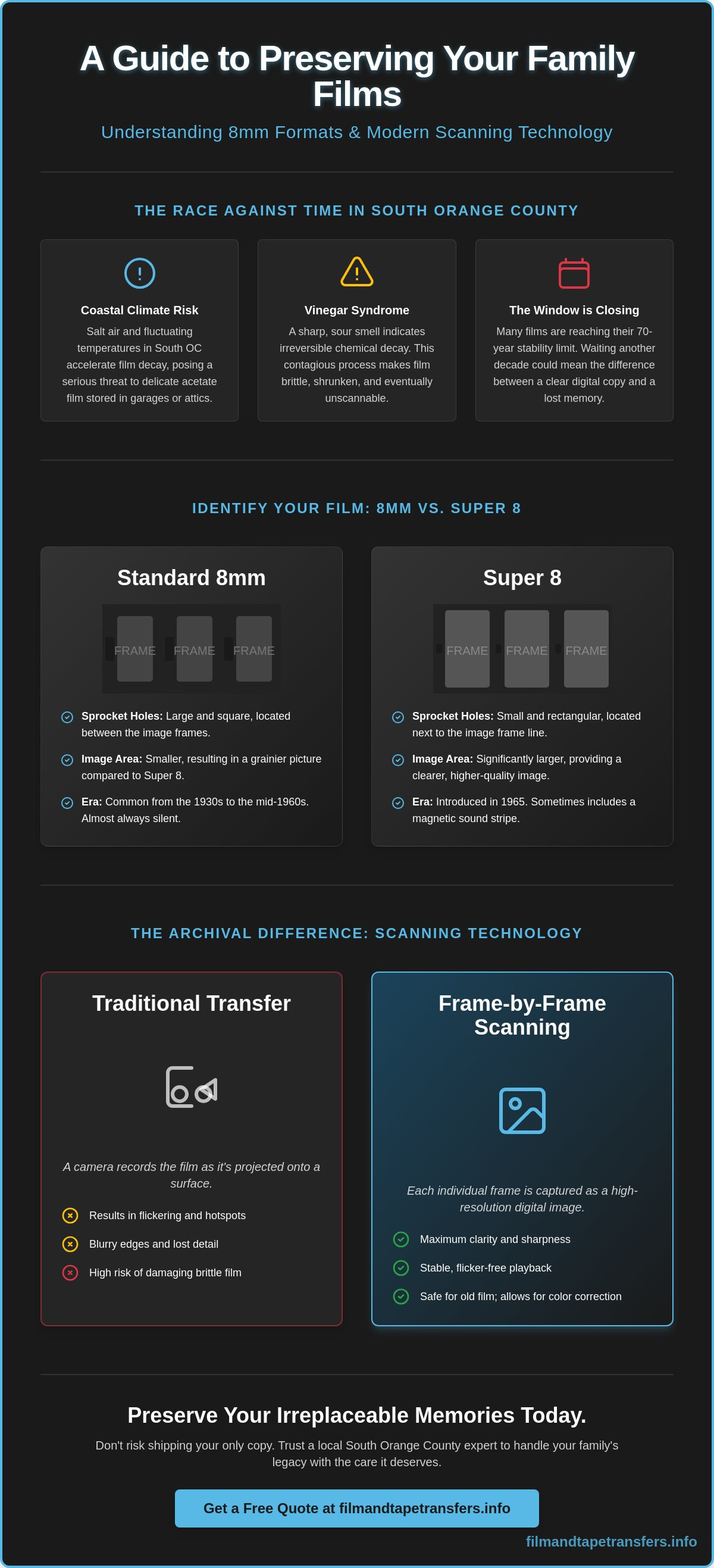
Many South Orange County families have boxes of old film tucked away in closets or garages. These reels often contain the only moving images of previous generations. 8mm film scanning is the professional process of capturing every individual frame of a movie reel using high-resolution digital sensors. Unlike older methods that simply recorded a projection, modern scanning treats every frame as a high-quality still photograph. To understand the 8mm film format history, it helps to recognize that these reels were designed for home viewing, not for a century of storage in a coastal climate.
The "Southern California Factor" is a specific challenge for local residents. Our region's unique blend of salt air and high temperatures creates a hostile environment for delicate acetate. Film is a living chemical medium. When it's stored in a Mission Viejo garage or an uninsulated attic in Aliso Viejo, the heat accelerates a process of molecular breakdown. By 2026, many of these films are reaching the 70 year mark, which is often the limit for stable acetate storage. The window for safe digitization is closing. Waiting another decade could mean the difference between a clear digital file and a pile of dust.
The Threat of Vinegar Syndrome in Laguna Woods
If you open a film canister in your Laguna Woods home and notice a sharp, sour odor, your memories are in immediate danger. This "Vinegar Syndrome" is the result of acetate decay releasing acetic acid. It's a contagious process that can spread from one reel to another. In the fluctuating humidity of South OC, this decay causes the film to shrink and warp. Once the film becomes too brittle, it can't safely pass through a scanner without snapping. Catching this early is the only way to preserve the footage before it reaches the point of no return.
Preserving Memories vs. Just 'Converting' Files
There's a significant difference between a cheap "transfer" and a professional archival scan. Older transfer methods, known as telecine, involved recording a projected image on a wall or through a lens. This often resulted in flickering, blurry edges, and lost detail. 8mm film scanning is a frame-by-frame digital reconstruction of history. This modern approach allows for precision color correction and scratch reduction. It doesn't just copy the film; it restores the vibrant life of a 1960s Laguna Beach summer or a San Clemente holiday. We focus on archival quality because these are more than just files; they're your family's legacy.
- Frame-by-Frame: Each image is captured individually for maximum clarity.
- Resolution: High-resolution sensors pick up details the naked eye might miss on a projector.
- Stability: Digital files don't decay, ensuring your memories are safe for the next century.
Understanding Your Collection: Identifying 8mm vs. Super 8 Reels
Identifying your film is the first step toward successful 8mm film scanning. Most family collections in South Orange County contain two main types of film. While they look similar at a glance, their technical requirements for digitization are different. Knowing which format you have helps you understand the quality you can expect and the total runtime of your memories. It's often helpful to organize your reels by format before bringing them in for a transfer.
Standard 8mm: The Post-War Family Staple
Regular 8mm, also known as Standard 8, was the primary home movie format from 1932 until the mid-1960s. It was actually created by using 16mm film and running it through the camera twice. You can identify it by the large, nearly square sprocket holes. These holes are almost as wide as the image frame itself. Standard 8mm typically runs at 16 frames per foot and is almost always silent. If your reels date back to the 1940s or 50s, they're likely this format. Because the image area is smaller, professional 8mm film scanning is necessary to pull out the fine details hidden in the grain.
Super 8: The 1960s Revolution
Super 8 film launched in 1965 and changed how families captured their lives. It offered a larger, clearer image by significantly reducing the size of the sprocket holes. This allowed more room for the actual picture. If your film is stored in the iconic blue or yellow Kodachrome boxes found in many San Clemente or Dana Point homes, it's likely Super 8. For a deeper look at this format, read our guide on What is Super 8 Film? A Preservation Guide for South Orange County Families.
You should also check your film for the "Sound Stripe" mystery. Look for a thin, rust-colored magnetic strip running along the edge of the film opposite the sprocket holes. If you see this brown line, your film has an audio track. This was common for Super 8 reels produced in the 1970s. Capturing this audio requires specialized equipment during the scanning process to ensure the sound stays synced with the picture.
Reel sizes are the final piece of the identification puzzle. Most families have a mix of three standard sizes:
- 3-inch reels: These hold 50 feet of film and provide about 3 to 4 minutes of footage.
- 5-inch reels: These hold 200 feet and last roughly 15 minutes.
- 7-inch reels: These hold 400 feet and offer nearly 30 minutes of cinematic history.
Properly identifying these reels is a key part of film preservation guidelines that help keep your media safe during handling. If you're still unsure about what's in your collection, a local expert at Film & Tape Transfer can provide a professional assessment and help you begin the journey of preserving your memories.
Frame-by-Frame Scanning vs. Traditional Transfers: Which is Better?
Not all 8mm film scanning methods are equal. In the past, many shops used "telecine" transfers. This method involved aiming a video camera at a projector screen or through a series of lenses while the film played in real time. By 2026, this approach is no longer acceptable for archival purposes. It often results in blurry edges, washed-out colors, and a distracting "strobe" or flicker effect. Because the camera and projector aren't perfectly synced, the digital version never looks as good as the original.
Modern technology uses frame-by-frame scanning to solve these issues. This process treats your movie reel like a series of thousands of individual high-resolution photographs. The scanner captures every single image (typically 16 to 24 frames per second) one at a time. These images are then digitally stitched together to create a smooth, flicker-free video. This method is safer for the film and produces a level of clarity that was impossible to achieve just a decade ago.
The Technical Superiority of Modern Scanners
Modern scanners use "Cool LED" light sources instead of the hot halogen bulbs found in old projectors. These LEDs provide consistent, vibrant light without the risk of burning or melting brittle acetate. High-resolution digital sensors also capture detail in the "over-scan" area, showing parts of the frame that home projectors used to crop out. For a deeper look at how we handle different film stages, see our guide on Super 8 Film Development vs. Transfer: A South Orange County Preservation Guide.
Why 2K and 4K Scanning is the Future-Proof Choice
Most South Orange County families now view their memories on large 4K televisions. Standard Definition (SD) files look pixelated and soft on these modern displays. High Definition (1080p) is a significant step up, but 2K and 4K scans provide the ultimate level of preservation. 8mm film actually contains more data than a standard 1080p scan can capture. By choosing a higher resolution, you ensure that the digital file has enough "information" for effective stabilization and grain management. This makes the final video look steady and professional on the screens of today and tomorrow.
- Resolution Comparison: 4K scans offer four times the pixel density of standard HD.
- Stabilization: Higher resolution allows software to remove camera shake without losing image quality.
- Grain Management: Professional scans balance the natural film grain to keep the "vintage" look without the digital noise.
Choosing frame-by-frame 8mm film scanning is an investment in the longevity of your family history. It moves your memories from a fragile physical format into a high-fidelity digital archive that's easy to share and impossible to wear out.
Preparing Your Film for Scanning: A South OC Resident's Checklist
Preparing for 8mm film scanning doesn't have to be a daunting task. Taking a few organized steps at home ensures your family history is handled with the highest level of care. By following a structured checklist, you help our technicians understand the priority and context of every reel. This preparation also makes the eventual digital files much easier to navigate and share with your relatives.
- Step 1: Inspect the condition. Look for physical warping or signs of "blocking," where the film layers stick together. While we previously discussed the smell of decay, simply identifying damaged reels helps us prioritize them for manual repair.
- Step 2: Organize chronologically. Check the original boxes for handwritten dates or locations. Arranging your reels in order helps tell a coherent story once they're digitized.
- Step 3: Avoid household cleaners. Never use water, window cleaner, or alcohol on your film. These substances can permanently strip the emulsion. Professional cleaning requires specialized, non-aqueous lubricants.
- Step 4: Consolidate small reels. If you have dozens of 3-inch reels, they can be consolidated onto larger 7-inch cinematic reels. This makes the scanning process more efficient and results in fewer individual digital files to manage.
- Step 5: Create a catalog. Write a simple list of your reels. This acts as a roadmap for the technician and ensures every digital file is named correctly.
Handling Brittle or Damaged Film Safely
In some cases, film becomes too brittle to run through a standard projector. If your reels are stuck together or have broken splices, don't attempt to force them open. Local experts in Aliso Viejo are better equipped for this delicate manual repair than high-volume, automated factories. We use professional splicing tape to fix breaks before the scanning begins. This careful human touch prevents further damage to the original acetate. If you're ready to protect your collection, you can start your 8mm film scanning project with a local specialist today.
Cataloging Your Memories for the Digital Age
Once the 8mm film scanning is complete, you'll need to decide on a final file format. Most families choose MP4 files because they're easy to share via email or social media. If you plan on doing your own professional editing, you might prefer a high-bitrate ProRes file. For more specific advice on handling collections in certain neighborhoods, see our guide on Super 8 Film Scanning in Laguna Woods: The Complete 2026 Preservation Guide. We recommend a "Year-Event-Location" naming convention for your files. A name like "1965-Christmas-Laguna-Beach.mp4" is much more useful than a generic label like "Reel 1." This simple step ensures your digital archive remains organized for the next generation.
Why Local Expertise Matters for 8mm Film Scanning in South OC
Choosing a partner for 8mm film scanning is a decision based on trust. National mail-in services like Legacybox often require you to ship your only copies of family history through a complex postal network. This creates significant anxiety for many South Orange County residents who fear their irreplaceable reels might be lost or damaged. When you choose a local specialist, you eliminate the risk of a package getting lost in a high-volume sorting facility. You also avoid the standard 6 to 12 week wait times often associated with national "box" companies. Local service means your film stays within reach and is processed with a level of attention that automated factories simply cannot match.
Direct communication is another major advantage of staying local. You get to speak directly with the technician who will actually handle your media. This ensures that your specific instructions, such as reel order or sound capture preferences, are followed exactly. Supporting local businesses in the Laguna Woods and Irvine area also means you're working with professionals who understand the regional history. We know the value of these reels because we're part of the same community. Your memories aren't just another order number in a database; they're a shared piece of our local heritage.
The 'White Glove' Service in South Orange County
Our service starts with a personalized assessment of every reel at the time of drop-off. We don't just put your film in a pile. We look for the technical issues discussed in previous sections, such as physical warping or Vinegar Syndrome, before the scanning process begins. You also have total control over your final format. While many national services provide a single digital link that might expire, we offer customized output options. This includes high-speed USB drives, secure Cloud storage, or even archival DVD and Blu-ray discs for those who prefer physical backups. This flexibility ensures your digital files are compatible with your current home setup.
Ready to Preserve Your Legacy?
Scheduling a drop-off in Laguna Woods or Mission Viejo is a simple, stress-free process. Our "Memories Restored" promise ensures that every frame is captured with precision and every reel is returned to you safely. We focus on archival quality because we understand that these films are the only way to hear a late relative's voice or see a long-gone family home again. Don't let your history fade away in a drawer. Preserve your family's 8mm film today with Film and Tape Transfers and give the next generation the gift of their own story.
Give Your Family History a Digital Future
Your film reels are the only physical link to your family's past. The coastal humidity of South Orange County makes immediate preservation a necessity. By choosing professional 8mm film scanning, you move these delicate memories from fragile acetate to high-resolution digital files that won't decay. Our frame-by-frame technology ensures every smile and holiday is captured with the clarity it deserves.
Film and Tape Transfers has served the South Orange County community for over 30 years. We offer convenient local drop-off locations in Laguna Woods, Aliso Viejo, and Mission Viejo to ensure your originals never leave the safety of our hands. You can trust our specialists to act as the dependable guardians of your personal history. It's time to share these stories with the next generation.
Start Your South OC Film Preservation Project Today
We look forward to helping you preserve your most cherished memories for years to come.
Frequently Asked Questions
How can I watch my 8mm film if I don't have a projector?
You can watch your footage by converting it into a digital file that plays on modern devices like smart TVs, tablets, or computers. Professional 8mm film scanning eliminates the need for bulky vintage equipment. Once digitized, you can share these files via USB drives, cloud links, or even private video hosting sites for family members to view anywhere.
Is 8mm film scanning safe for my old, brittle reels?
Modern frame-by-frame scanning is the safest method for handling fragile or brittle acetate film. Unlike traditional projectors that use high-tension gears and hot bulbs, professional scanners use cold LED light sources and sprocketless transport systems. This gentle handling prevents tearing or burning, allowing us to capture images from reels that are otherwise too delicate to play.
How much does it cost to digitize 8mm film in South Orange County?
Local rates in May 2026 typically range from $0.20 to $0.50 per foot depending on the resolution and restoration levels. For example, a 50-foot reel at The Video Editor in Newport Beach is currently $14.99, while DVD Your Memories in Irvine offers premium transfers for $23.49 per small reel. These prices often include basic cleaning and digital output options.
What is the difference between 8mm and Super 8 film?
The primary difference lies in the size of the sprocket holes and the resulting image area. Standard 8mm film has larger, nearly square holes, while Super 8 film features much smaller holes to allow for a 50% larger picture frame. Super 8 was introduced in 1965 as an improvement to provide better clarity and easier loading for home movie cameras.
Can you scan 8mm film that has sound?
We can capture audio from 8mm film that contains a magnetic or optical sound stripe. You can identify sound film by looking for a thin, rust-colored magnetic band running along the edge of the reel. While most home movies from the 1950s are silent, many Super 8 films from the 1970s include audio that we sync during the scanning process for an additional fee.
How long does the 8mm film scanning process take locally?
Local turnaround times in South Orange County generally range from 5 to 10 business days for standard orders. This is significantly faster than national mail-in services, which often have 6 to 12 week backlogs. Because we handle everything in-house, we can often provide expedited service for special occasions like birthdays or memorial services if you drop off your reels directly.
Will I get my original film reels back after they are scanned?
You will always receive your original physical reels back in their original condition. We understand that these are irreplaceable family heirlooms. After the 8mm film scanning is complete, we return your films along with your new digital files. We recommend keeping the physical originals in a cool, dry place as a permanent master backup for your collection.
What is the best digital format for my scanned 8mm movies?
The MP4 format is the best choice for most families because it offers high compatibility with smart TVs, smartphones, and social media. It provides a great balance between file size and image quality. If you are a professional editor, you might request ProRes 422 files, which preserve more data for advanced color grading and stabilization during your own editing projects.