


What is Super 8 Film? A Preservation Guide for South Orange County Families
While clearing out a dusty corner of a Dana Point attic last Saturday, the Miller family uncovered a plastic bin filled with small, yellow Kodak boxes containing narrow reels of film. They immediately asked themselves, what is super 8, and more importantly, are these silent memories still playable? It's a common scene for many families across South Orange County who stumble upon archives from the 1960s and 1970s. You likely feel a deep connection to these reels but also a growing fear that the footage is degrading every day it sits in a hot garage.
We understand that these aren't just plastic strips; they're irreplaceable records of your family's legacy. You deserve to see those flickering images of San Clemente beach trips and holiday mornings without the stress of finding a working projector. This guide will explain the technical history of these 8mm cartridges and provide a clear path to preservation. You'll learn how to identify your specific film type and discover how a local expert can help you scan these moments into a high-quality digital format.
Key Takeaways
- Learn the origins of Kodak's 1965 revolution and understand exactly what is super 8 film compared to older standard formats.
- Discover how to visually identify your family’s film reels by checking the size of the center spindle hole and sprocket placements.
- Protect your irreplaceable memories by learning how to detect vinegar syndrome and other signs of chemical breakdown.
- Find out how to safely clean your film reels using archival-safe materials before starting the digitization process.
- Compare the differences between basic transfers and professional frame-by-frame scanning to ensure the highest quality results for your legacy.
Defining the Super 8 Format: The 1965 Revolution of Home Movies
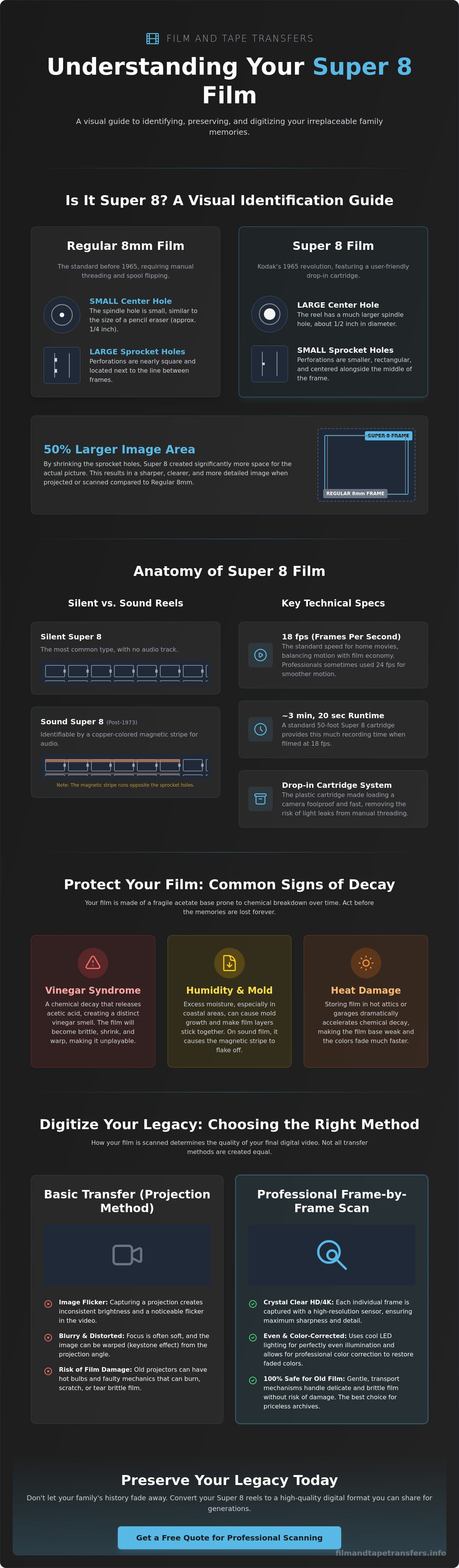
Eastman Kodak changed the landscape of personal history in April 1965 with the release of the Super 8 film format. This innovation was a direct response to the technical limitations of standard 8mm film, which had been the consumer standard since 1932. When families ask what is super 8, the answer lies in the name itself. The "Super" refers to a frame size that's approximately 50 percent larger than its predecessor. By shrinking the size of the sprocket holes on the side of the film strip, Kodak created more room for the actual image. Super 8 acted as the primary catalyst for the amateur home movie boom that defined the second half of the 20th century.
Why Super 8 Changed Everything for Families
The format removed the technical barriers that once made filming a chore. Before 1965, capturing a family vacation required manual threading and flipping the film spool halfway through, which often led to ruined footage from light leaks. Super 8 introduced a convenient drop-in cartridge system. This design eliminated the "jamming" issues common in older 16mm and 8mm cameras. Each cartridge contained 50 feet of film, providing roughly 3 minutes and 20 seconds of recording time at 18 frames per second. This simplified process made high-quality movie-making accessible to residents across Irvine and Mission Viejo for the first time. It turned every parent into a documentarian of their own household.
The Aesthetic: Why We Still Love the 'Super 8 Look' in 2026
The visual characteristics of Super 8 are unmistakable and deeply nostalgic. The format is known for its warm color saturation, organic grain, and a slight rhythmic jitter. These elements create a dreamlike quality that feels more personal than the sterile clarity of modern 4K video. Modern digital filters frequently try to mimic this specific analog texture, but they rarely succeed in capturing the chemical depth of real film stock. There's a heavy emotional weight in seeing 1970s Laguna Hills or a 1982 Dana Point Christmas through an authentic Super 8 lens. To truly understand what is super 8, one must appreciate how its imperfections make the memories feel more alive. It remains a trusted medium for preserving the soul of a moment.
The Technical Anatomy: How Super 8 Works
Super 8 film measures exactly 8mm in width. It features smaller sprocket holes than its predecessor, which allows for a 50% larger image area on the same physical strip of plastic. These rectangular perforations sit on only one side of the film. They engage with a mechanical claw to pull each frame into position behind the lens. When families ask what is super 8, they are often discovering a technical evolution that made home movies more vivid and easier to capture than ever before.
Frame rates dictate the "feel" of the motion you see on screen. Most home movies shot between 1965 and the late 1970s run at 18 frames per second. This speed was the standard because it saved money on film stock while still providing acceptable motion. Professional creators or those filming for television often used 24 frames per second. This higher rate creates smoother motion but consumes film 33% faster. Proper storage is vital for these strips because the acetate base is prone to chemical decay. This film preservation guide explains how "vinegar syndrome" can destroy a collection if it isn't digitized before the plastic breaks down.
Silent vs. Sound Super 8 Reels
In 1973, the format evolved with the introduction of a magnetic sound stripe. You can identify these reels by a thin, copper-colored line running along the edge opposite the sprocket holes. This magnetic material makes the film slightly thicker than silent stock. It requires specialized scanning equipment with magnetic playback heads to capture the audio properly during a transfer. Families in the San Clemente area often find that their sound reels have developed a muffled audio quality. This usually happens when the magnetic particles begin to flake off due to decades of exposure to coastal humidity levels.
The Cartridge System Explained
The Super 8 system relied on a plastic, light-proof cartridge. This design allowed users to load a camera in seconds without touching the raw film. It's the primary reason home movies became a household staple after its 1965 launch. Each cartridge has specific mechanical notches. These notches tell the camera's light meter exactly which ISO, or film speed, to use for the exposure. It's common to find unexposed cartridges at Dana Point estate sales even today. While these vintage rolls might be 50 years old, they represent a unique era of analog history. If you find a box of finished reels in a closet, a professional film and tape transfer can reveal the memories hidden on those 8mm strips.
Super 8 vs. Regular 8mm: Identifying Your Family’s Film Reels
Families often find boxes of reels in South Orange County attics without knowing the specific format. The most common confusion involves Regular 8mm, Super 8, and Single-8. While these film types look similar at a glance, clear physical markers help you identify them. Understanding what is super 8 starts with looking at the sprocket holes. On Standard 8mm film, these holes are nearly square and quite large. Super 8 film features smaller, elongated sprocket holes located next to the center of each image frame.
Super 8 has a 50% larger image area than its predecessor. This design choice allowed for better picture quality without increasing the physical width of the film strip. Single-8 is a rarer format from Fujifilm that uses the same dimensions as Super 8 but comes in a different cartridge. Most local families will find they own either Standard 8mm or Super 8 reels from their childhood years.
The Spindle Hole Test
The easiest way to identify your film involves looking at the center of the reel. Regular 8mm reels have a small center hole measuring approximately 8mm in diameter. Super 8 reels feature a much larger center hole that measures about 13mm. You can't fit a Super 8 reel onto a Standard 8mm projector arm without a specific adapter. This matters if you're trying to use a vintage projector in Aliso Viejo to preview your reels. Trying to force the wrong reel can damage the delicate plastic or bend the film. Our team uses specialized equipment to safely handle both sizes during the film transfer process.
Frame Size and Aspect Ratio
The technical differences between these formats impacted how your family memories look on screen. Standard 8mm film has a frame area of 4.5mm by 3.3mm. By comparison, Super 8 offers a larger frame area of 5.79mm by 4.01mm. This shift to Super 8 improved clarity and brightness for home viewers. The smaller sprocket holes allowed more room for the actual image. When we perform a high-quality scanning service, this extra surface area results in a sharper digital file. Knowing what is super 8 helps you set expectations for the final resolution of your digitized memories. We focus on capturing every detail from these larger frames to preserve your history accurately.
Handling and Preserving Your Super 8 Legacy in South Orange County
Understanding what is super 8 film is the first step toward saving your family history. These small reels hold decades of birthdays, holidays, and California beach days. However, physical film is fragile. You must take specific steps to stop the clock on decay. If you find a box of reels in your home, follow these four steps to stabilize the media.
- Step 1: Inspect the film for a sour, vinegar-like odor. This scent is a clear sign of chemical breakdown.
- Step 2: Gently clean the film surface. Use specialized lint-free cloths and an archival-grade film cleaner to remove dust and oils.
- Step 3: Check the splices. Old tape or cement joins often fail after 40 years. Repair these gaps using fresh archival splicing tape.
- Step 4: Relocate your collection. Move reels out of humid Laguna Woods garages and into a climate-controlled closet inside your home.
Taking these actions helps maintain the integrity of the plastic base. When you know what is super 8 and how it reacts to the environment, you can better protect the images from fading or becoming brittle.
The Threat of Vinegar Syndrome in Coastal California
Salt air and high humidity levels in Dana Point and San Clemente create a harsh environment for acetate film. When local humidity levels exceed 50%, the chemical breakdown of the film base accelerates. You might see a white powder on the edges of the reel or notice the film is warping into a cupped shape. These are signs of advanced deterioration. Professional preservationists always smell the film first. This simple audit identifies which reels need immediate intervention before the images are lost forever. If the vinegar smell is strong, the film is actively off-gassing and should be separated from healthy reels.
Archival Storage Best Practices
Many families keep their films in the original cardboard boxes from the 1960s or 1970s. These boxes are actually harmful. Cardboard is acidic and traps moisture against the film. Switch to vented plastic archival containers. These specialized cases allow the film to breathe and prevent the buildup of acidic gases. To preserve your collection through 2030 and beyond, aim for a consistent temperature below 65 degrees Fahrenheit. Stability is key. Frequent temperature swings cause the film to expand and contract, which leads to cracks in the emulsion. If you aren't sure about the condition of your reels, you can schedule a professional film inspection to protect your family legacy.
Professional Super 8 Scanning: From Attic to Screen
Finding an old box of reels often leads to the question: what is super 8 and how do I watch it? While setting up a vintage projector seems nostalgic, the "projector-to-wall" method usually fails. This DIY approach results in heavy flickering, uneven lighting, and lost detail. Professional scanning preserves the full frame without these artifacts. Since 2010, digital scanning has replaced telecine as the industry standard for archival preservation. This shift ensures that 100% of the visual information on the film strip is captured accurately.
Modern frame-by-frame scanning is superior to old telecine transfers. Telecine records the film as it moves, which often causes motion blur. Frame-by-frame technology stops at every individual image to take a high-resolution photograph. This process captures details that were invisible on a home projector in the 1970s. It also allows for digital restoration. Films from the 1960s often suffer from color shifts where scenes turn bright pink or orange. Digital tools can rebalance these colors and minimize the appearance of physical scratches. Many families choose to combine this service with a vhs to digital transfer to modernize their entire home movie library at once.
Frame-by-Frame Scanning in Laguna Hills
Our local lab uses specialized sensors to capture every reel in 2K or 4K resolution. This ensures your family history is preserved at a higher quality than the original projection. Choosing a local South Orange County expert is safer than using "big box" mail-in services. Industry data suggests that roughly 1% of mail-in packages face shipping delays or loss. Hand-delivering your memories to our Laguna Hills location eliminates this risk. You get to speak directly with the technicians who handle your irreplaceable film.
Next Steps for Your Film Collection
Before bringing your reels to us, try to organize them by year or event. We offer different digital formats to suit your needs. You can choose MP4 files for easy sharing on smartphones or ProRes files if you plan to edit the footage. For families with mixed media, our slide scanning service handles 35mm transparencies alongside your film. Understanding what is super 8 is the first step toward saving your history. It's time to move those reels from the attic to your modern screens.
Bring Your Super 8 Memories Into the Digital Age
Understanding what is super 8 film helps you recognize the value of those small reels tucked away in your attic. These films captured the 1965 home movie revolution, offering a larger frame size and clearer image than earlier formats. Because film stock naturally degrades over time, professional preservation is the most reliable way to protect your family history. Proper storage helps, but high quality scanning ensures these moments remain accessible for future generations.
Our team has served South Orange County families since 1990. We specialize in frame-by-frame 8mm and Super 8 scanning to capture every detail of your original footage. You don't have to worry about shipping your irreplaceable reels across the country. We provide a local drop-off location in the Laguna Woods area to keep your memories safe and close to home. It's time to move your legacy from the dusty projector to the modern screen.
Preserve your Super 8 memories with South Orange County's trusted experts
Your family's story is too important to leave to chance. We look forward to helping you rediscover your favorite moments soon.
Frequently Asked Questions
Is Super 8 film still being made in 2026?
Yes, Super 8 film is still being manufactured by Kodak as of 2026. The company continues to produce popular stocks like Ektachrome 100D and Tri-X Black and White to meet the demand from both hobbyists and professional filmmakers. This ongoing production ensures that families can still use vintage cameras to capture new memories on the same format used decades ago.
Can I watch Super 8 film on a regular 8mm projector?
You cannot play Super 8 film on a standard 8mm projector because the sprocket holes and spindle sizes don't match. Super 8 film features smaller sprocket holes and a larger center spindle hole measuring 0.5 inches. Regular 8mm projectors use a smaller 0.3125 inch spindle. Attempting to use the wrong equipment can lead to torn film or permanent damage to the acetate base.
How much video is on a standard 50ft Super 8 reel?
A standard 50ft reel contains approximately 3 minutes and 20 seconds of footage when recorded at the standard speed of 18 frames per second. If the film was captured at the professional speed of 24 frames per second, the runtime is roughly 2 minutes and 30 seconds. Understanding what is super 8 capacity helps you estimate the total length of your archive before starting a film and tape transfer.
What happens if my Super 8 film smells like vinegar?
A vinegar scent indicates Vinegar Syndrome, which is a chemical breakdown of the acetate film base. This decay is irreversible and can spread to other reels stored in the same container if they aren't isolated. Once this smell is noticeable, the film has typically lost 10% or more of its structural integrity. You should seek professional scanning immediately to preserve the memories before the film becomes too brittle to handle.
Can you digitize Super 8 film that has sound?
Yes, we can digitize Super 8 film that includes a magnetic audio track. About 15% of Super 8 film produced after 1973 featured a thin, copper-colored magnetic stripe along the edge for sound recording. Our specialized scanning equipment captures both the high-definition image and the synchronized audio track. This process allows you to hear the original voices and ambient sounds from your family gatherings.
How do I tell if my film is 8mm or Super 8?
You can identify the format by looking at the size and position of the sprocket holes. Super 8 film has much smaller, rectangular sprocket holes located in the center of each frame's height. Standard 8mm film has larger, nearly square holes that align with the frame line. Knowing what is super 8 versus regular 8mm is essential for choosing the correct gate during the digitization process.
Is it worth digitizing old Super 8 reels if they look dark?
It's often worth digitizing dark reels because modern frame-by-frame scanners can recover details that are invisible to the naked eye. Professional sensors pull image data from underexposed film that a traditional projector bulb simply cannot penetrate. In 90% of cases, digital color correction significantly improves the visibility of faces and backgrounds. We focus on saving every possible detail to ensure we are preserving memories for your family.
Where can I get Super 8 film scanned near Laguna Woods?
You can get your Super 8 film scanned at our professional lab located in Mission Viejo, which is just 5 miles from Laguna Woods. We provide local families with a trusted environment where their delicate media never leaves our hands. Our team offers a secure drop-off process to help South Orange County residents begin their preservation journey. We specialize in high-quality conversion that turns fragile reels into lasting digital files.