


Super 8 Film Development vs. Transfer: A South Orange County Preservation Guide
Last Saturday, a family in San Juan Capistrano discovered a dusty shoebox containing twelve Super 8 reels from a 1978 summer vacation. Like many South Orange County residents, they felt the immediate pressure of time. These physical films can degrade by up to 10% in quality every decade if they are stored in humid coastal conditions. You might think you need super 8 film development to see these moments again, but that technical term is often misunderstood by those looking to modernize their archives.
It's frustrating to hold a piece of your history and realize you don't have a working projector to view it. You want to ensure these irreplaceable memories aren't lost to vinegar syndrome or heat damage. This guide promises to explain the critical difference between chemical development and digital scanning. You'll learn exactly which service you need to get your family legacy onto your smartphone or television safely. We will walk through the steps to help you become a trusted guardian of your family's past while ensuring your films stay protected for the next fifty years.
Key Takeaways
- Clarify the technical difference between chemical super 8 film development and digital scanning to ensure your memories are handled correctly.
- Compare turnaround times and digital file options to find the most efficient way to preserve and share your vintage footage.
- Identify the environmental factors in Southern California that could be causing silent, irreversible damage to your film collection.
- Learn why choosing a local specialist for hand-delivery in South Orange County is the safest way to protect your irreplaceable legacy.
- Discover a trusted, professional process that treats your family’s history with the care and nostalgia it deserves.
Super 8 Film Development vs. Transfer: What Do You Actually Need?
Many South Orange County residents find boxes of old family movies while cleaning out closets or garages in Mission Viejo or San Clemente. There's often confusion about the next steps. You might think you need super 8 film development, but the practical reality depends on the current state of your media. Understanding the difference between chemical development and digital transfer is the first step toward preserving your family history.
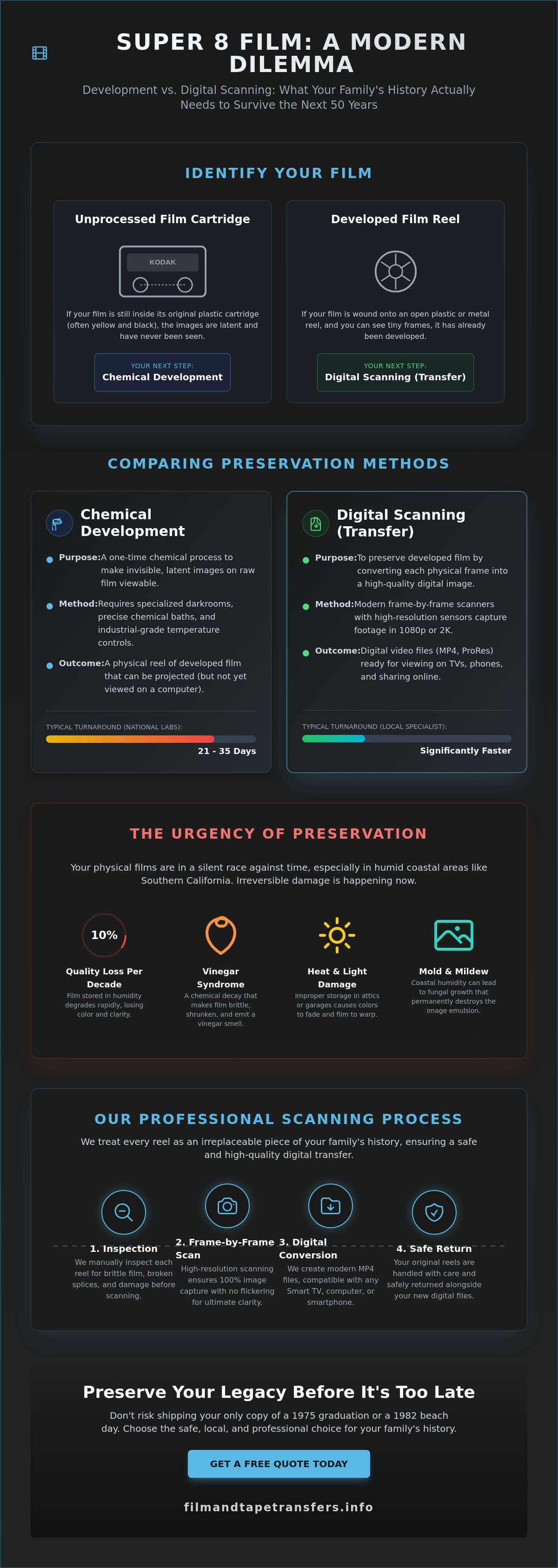
The Super 8 film format was introduced in 1965, and it quickly became the standard for home movies. Because this film was popular for decades, the items you find today usually fall into two categories: unprocessed cartridges or developed reels. Film and Tape Transfers acts as a specialized expert for families who have already-developed reels and want to see those images on modern screens. Most people in Orange County don't need a chemical lab; they need a high-resolution digital scanner.
When to Seek Chemical Development
Chemical development is only for film that's never been processed. You can identify this film by its housing. It's usually found inside a rectangular yellow and black Kodak cartridge. If the film is still inside this plastic shell, the images are latent and invisible. Super 8 film development requires a specialized laboratory equipped with specific chemical baths and darkroom environments. This process turns the raw film into a viewable strip of pictures. It's a one-time chemical procedure. Most local shops don't perform this in-house because it requires high-grade industrial chemistry and precise temperature controls.
When Digital Scanning is the Priority
If your film is already on an open plastic or metal reel, it's already been developed. You can see the tiny individual frames if you hold the strip up to a light source. For these reels, you don't need chemicals. You need a digital transfer. This process uses high-resolution sensors to capture every frame in 1080p or 2K quality. Modern scanning technology ensures that the vibrant colors and details from 1970 or 1980 are preserved in a format you can actually watch. Super 8 transfer is the bridge between legacy media and modern devices.
Film and Tape Transfers focuses on this critical digitization phase. We provide a steady, reliable service for those who want to move their memories from a dusty box to a cloud drive or USB stick. Our process includes:
- Inspection of the physical film for brittle edges or broken splices.
- Frame-by-frame scanning to ensure 100% image capture.
- Conversion into digital files compatible with smart TVs and smartphones.
- Careful handling of original reels to ensure they return to you safely.
By choosing a local specialist, you avoid the risks of shipping your only copy of a 1975 graduation or a 1982 beach day to a massive, impersonal warehouse. We treat every reel as a unique piece of history.
Comparing Your Options: Lab Processing vs. Professional Scanning
Families in South Orange County often face a choice between chemical lab work and digital transfer services. These are two distinct stages of preservation. Chemical labs focus on super 8 film development, which is the process of turning raw, unexposed film into a viewable negative or positive. This stage requires specialized darkroom equipment and toxic chemicals. Most national labs currently have turnaround times of 21 to 35 days for this process. If your film is already developed and sitting on reels, you need a professional scanning service rather than a chemical lab.
Local scanning services in cities like Mission Viejo or Laguna Niguel offer a faster, more secure alternative to shipping reels across the country. National labs often charge flat-rate fees per 50-foot cartridge. Local specialists typically use per-foot pricing models. This ensures you only pay for the actual footage recovered. Digital outputs like MP4 or ProRes files allow for immediate viewing on smart TVs and smartphones. The Urgency of Preservation becomes clear when you realize that film stored in coastal humidity can develop mold or vinegar syndrome within a few decades. Handling these delicate materials locally reduces the risk of loss or damage during transit.
The Technical Breakdown of Super 8 Scanning
Professional scanning has replaced the old "telecine" method of the 1990s. Telecine involved filming a wall projection with a video camera, which caused flickering and blurry edges. Modern frame-by-frame scanning captures each individual image on the film strip as a high-resolution data point. Most families find that 1080p resolution is the sweet spot for home movies. It provides 1920x1080 pixels of clarity, which perfectly captures the organic grain of Super 8 without creating massive, unmanageable files. Every reel undergoes a manual cleaning and lubrication process to remove dust and static before the transfer begins.
Why DIY Scanning Often Falls Short
Consumer-grade scanners available on retail sites often use cheap plastic gears and low-end sensors. These machines lack the "cool" LED light sources found in professional gear, increasing the risk of "burnt" frames if the film jams. Low-end scanners also struggle with warped film or torn sprockets, which are common in reels from the 1960s and 70s. Professional transfers include scene-by-scene color correction. This is vital for super 8 film development projects where the original chemistry has shifted toward a heavy orange or magenta tint over time. If you want to ensure your family history is safe, preserving your film with professional equipment is the most reliable path forward.
The Urgency of Preservation: Why Your Super 8 Reels Are at Risk
Super 8 film was the standard for capturing family life from 1965 through the late 1980s. These reels hold the only visual record of birthdays at Laguna Hills parks or holidays in Mission Viejo. However, these memories face a silent countdown. Proper super 8 film development was just the first step in a long journey. Today, the acetate base of the film is physically breaking down. This chemical decay, known as vinegar syndrome, can destroy a collection in a matter of months once it begins.
Southern California weather plays a significant role in this process. While we enjoy the sun, the heat and humidity in South Orange County garages and attics accelerate acetate decomposition. When temperatures rise above 70 degrees Fahrenheit, the chemical bonds in the film weaken. This leads to shrinking and warping. Digitization serves as a digital insurance policy. It creates a permanent record that doesn't rot or fade over time.
The "Projector Problem" adds another layer of risk. Old projectors often have dried-out rubber belts or sharp metal teeth. Running a brittle reel through a 40-year-old machine can cause instant snapping or heat damage from the bulb. Professional Preserving Your Legacy resources suggest that physical playback is the leading cause of accidental film loss for home users. One wrong turn of a plastic gear can ruin decades of history.
Identifying Film Decay at Home
You can check the health of your reels in your Mission Viejo or Aliso Viejo home using simple sensory cues. Open the film canister and take a quick sniff. A sharp, acidic scent like household vinegar indicates active chemical decay. Look for visual signs such as "cupping," where the film edges curl inward, or a white, waxy powder on the surface. If you see these signs, don't attempt to play the film. Place the reel in a cool, dry area and seek professional super 8 film development and transfer services immediately to save the remaining images.
The Safety of Professional Handling
We act as a trusted guardian for your irreplaceable media. Our professional scanners use a sprocketless transport system. This means nothing pulls on the fragile perforations of your film. We also perform manual splicing to fix breaks and replace old, yellowed tape. This preparation ensures the film moves smoothly during the scanning process. Our expertise extends to all formats, including vhs to digital transfer, ensuring every part of your family history is protected. We focus on precision to deliver high-quality results that preserve your story for future generations.
Choosing a Local Specialist in South Orange County
Handing over a box of family memories is a significant decision. For residents in Laguna Woods, Irvine, and Mission Viejo, the option for local drop-off removes the anxiety often associated with super 8 film development and transfer. You don't have to trust a national courier with your only copy of a 1965 family vacation. According to industry logistics data from 2022, package loss and damage rates can fluctuate during peak seasons, making shipping irreplaceable reels a gamble most families aren't willing to take.
Local service means you can talk directly to the technician who will actually touch your film. This personalized approach ensures your project isn't just a barcode in a massive factory. You get to explain which reels are the most important and discuss any specific concerns about film condition or color fading. It's a level of care that builds the trust necessary when preserving personal history. Our clients appreciate knowing exactly where their media is at every moment of the process.
Serving the South Orange County Community
We provide a dedicated "Media Digitization" hub for neighbors in San Clemente, Dana Point, and Laguna Hills. Our 30-year history in archival work has made us a trusted guardian for local family collections. Many families arrive with bulk containers of media gathered from attics or storage units. We help organize these collections, turning a chaotic pile of reels into a structured digital library. Supporting a local small business means you're investing in expertise that stays within the community. We've seen how much these films mean to our neighbors, and we treat every frame with the respect it deserves.
What to Look for in a Scanning Service
Transparency is the most important factor when selecting a provider. You should always ask for a clear breakdown of costs. Avoid services that use confusing setup fees or hidden handling charges. A professional service will be upfront about what you're paying for. You should also consider the delivery method. We provide high-quality digital files on USB drives for long-term storage, as well as cloud delivery for easy sharing with relatives across the country. If you find other types of media while cleaning out your closets, we also provide a specialized slide scanning service to help round out your digital archive.
Before you commit to a service, ask these essential questions:
- Is the super 8 film development or scanning done entirely on-site?
- What steps do you take to clean the film before the transfer process?
- Do you offer custom file naming to help organize my digital library?
- Can I see a sample of a transfer from a similar film stock?
Choosing the right partner is the final step in ensuring your memories survive for the next generation. Visit our local office to preserve your Super 8 reels with experts who care.
Preserving Your Legacy with Film and Tape Transfers
Your family films are more than just old plastic reels. They represent a window into your personal history. We recognize that these items are irreplaceable. Our team treats every reel with the same care we would give our own family archives. We focus on high-quality scanning for both Super 8 and 8mm formats to ensure every detail is captured. This commitment to quality means your memories will look as vivid as the day they were filmed.
We serve families across South Orange County. Whether you are located in Laguna Woods, Mission Viejo, or San Clemente, our local expertise is available to you. We handle the entire process with a steady, professional hand. This ensures your physical media remains safe while we create high-definition digital copies for you to share with the next generation. Our process is designed to be both nostalgic and professional, honoring the past while using modern technology.
The Film and Tape Transfers Difference
Our business model is built on a single goal: media preservation. We don't sell cameras, projectors, or film stock. This choice allows us to focus 100% of our resources on your conversion project. By specializing in archival quality, we provide a level of precision that general electronics stores cannot match. Your films never leave our sight, providing a secure environment for your most precious memories. We act as a trusted guardian for your history.
Get Started with Your Super 8 Project
Preparing your collection is a simple process. Start by grouping your reels by year or event. Labeling them clearly helps us maintain the chronological order of your family story. If you have a large collection, we offer free shipping on orders over $199 for our South Orange County neighbors. This makes it easier to handle bulk transfers of Super 8 and 8mm film without extra costs or logistical stress.
While the era of chemical super 8 film development has largely transitioned to digital archiving, our role is to ensure those developed reels live on. Contact our local team today for a custom quote or a consultation. We are ready to help you move your history from the attic to your modern devices. Our team is standing by to provide the professional results your family deserves.
Secure Your Family History Today
Your vintage reels are more than just plastic and chemicals; they're the only physical record of your family's earliest milestones. Understanding the technical difference between super 8 film development and high-resolution scanning ensures you make the right choice for these irreplaceable moments. Since 1990, we've helped families across South Orange County protect their history from the natural decay that threatens film stored in closets or garages. Professional archival preservation isn't just about modernizing a format; it's about stopping the clock on degradation.
We've served as the trusted local expert for residents in Irvine, Mission Viejo, and Laguna Woods for 34 years. Our team specializes in the delicate process of archival preservation, ensuring every frame is captured with precision. Don't let another 10 years of heat and humidity fade your memories into static. It's time to bring those stories back to life so you can share them with the next generation.
Preserve your South Orange County family memories. Start your Super 8 transfer today!
Your legacy deserves to be seen clearly again, and we're here to help you make that happen.
Frequently Asked Questions
Is Super 8 film development the same as scanning?
No, super 8 film development is the chemical process that makes images visible on the physical reel. Scanning is the separate step of converting those developed images into a digital file. You must develop unexposed film before a transfer is possible. Our team handles the transition from physical media to digital formats to ensure your memories are safe and viewable on modern devices.
Can I watch my Super 8 film without a projector?
You can watch your Super 8 film without a projector by converting the reels into digital files like MP4 or MOV. Projectors are increasingly rare, with many units manufactured between 1965 and 1981 now suffering from mechanical failure. Digitizing your film allows you to view your family history on a smartphone, tablet, or smart TV. This process preserves the original footage while making it accessible for daily viewing.
How much does it cost to digitize Super 8 film in South Orange County?
Costs for digitizing Super 8 film in South Orange County depend on the total footage length and the specific reel size, such as 3 inch or 7 inch diameters. Most professional labs provide custom quotes based on the number of feet of film processed. We recommend bringing your collection in for a physical assessment to get an accurate estimate. Local experts ensure your irreplaceable reels are handled with care throughout the process.
What happens if my Super 8 film is broken or brittle?
We can often repair broken or brittle film using professional splicing techniques before the transfer begins. Film stored in attic temperatures above 80 degrees Fahrenheit often becomes fragile over time. Our technicians inspect every inch of your media for damage or vinegar syndrome. We use specialized cleaning solutions and archival tape to stabilize the film, ensuring a smooth path through the scanner for the best possible digital result.
How long does the Super 8 film transfer process take?
The Super 8 film transfer process typically takes 14 to 30 days depending on the size of your order. Larger family archives containing 20 or more reels may require additional time for careful cleaning and frame by frame capture. We prioritize quality and precision to ensure every memory is preserved correctly. You'll receive updates as your film moves through our local lab, providing peace of mind during the preservation journey.
Can you digitize Super 8 film with sound?
We can digitize Super 8 film with sound if the reel features a thin copper colored magnetic stripe along the edge. While roughly 90 percent of Super 8 film produced was silent, sound film became more common after 1973. Our equipment captures both the visual frames and the audio track simultaneously. This dual capture ensures that the voices and ambient sounds of your past stay perfectly synced with the moving images.
Is it safe to mail my film reels for development?
It's safe to mail your reels for super 8 film development when you use a carrier with real time tracking like UPS or FedEx. We recommend using a sturdy box rather than a padded envelope to prevent crushing during transit. Many customers in South Orange County prefer our local drop off options for added security. If you choose to mail your items, our Film & Tape Transfer team provides clear shipping instructions to protect your memories.
What is the best resolution for Super 8 film scanning?
The best resolution for Super 8 film scanning is 2K or 4K to capture the maximum detail found in the film grain. A Super 8 frame is small, measuring approximately 5.79mm by 4.01mm, so high resolution sensors are necessary for clarity. Standard definition transfers often lose the sharpness present in the original emulsion. Choosing a higher resolution ensures your digital files remain high quality as screen technology continues to advance in the coming years.