


Professional Tape Digitizing Service in Laguna Woods & South Orange County (2026)
Imagine finding a dusty shoe box in your Laguna Woods closet labeled "Summer 1995" only to realize the footage of your daughter's first steps is trapped on a format you can no longer play. For many families across South Orange County, these magnetic tapes degrade every year they sit in a humid garage or attic. You want to save these moments, but the fear of losing your only copy in the mail often makes it hard to choose a tape digitizing service you can trust.
We understand that these aren't just plastic cassettes; they're your family's history. This guide shows you exactly how to safely preserve your legacy by selecting a local expert and preparing your media for a seamless transfer. You'll learn why specialists like The Video Editor, who've served the community since 1993, keep your originals safe while providing high-quality files for modern devices. We'll walk through the entire preservation process from identifying old Hi8 tapes to selecting the best storage options for 2026 and beyond.
Key Takeaways
- Understand why immediate action is necessary to stop magnetic tape degradation and prevent permanent data loss.
- Discover why choosing a local tape digitizing service in South Orange County offers better security and faster results than risky mail-in kits.
- Learn how to identify common formats like VHS and Hi8 to ensure you choose the right transfer process for your specific media.
- Master a simple inspection and labeling process to guarantee your digital files are organized and high-quality.
- Gain peace of mind by understanding how a trusted local guardian keeps your original media safe while delivering modern, accessible digital files.
Why Your Legacy Tapes Need a Digitizing Service in South Orange County Today
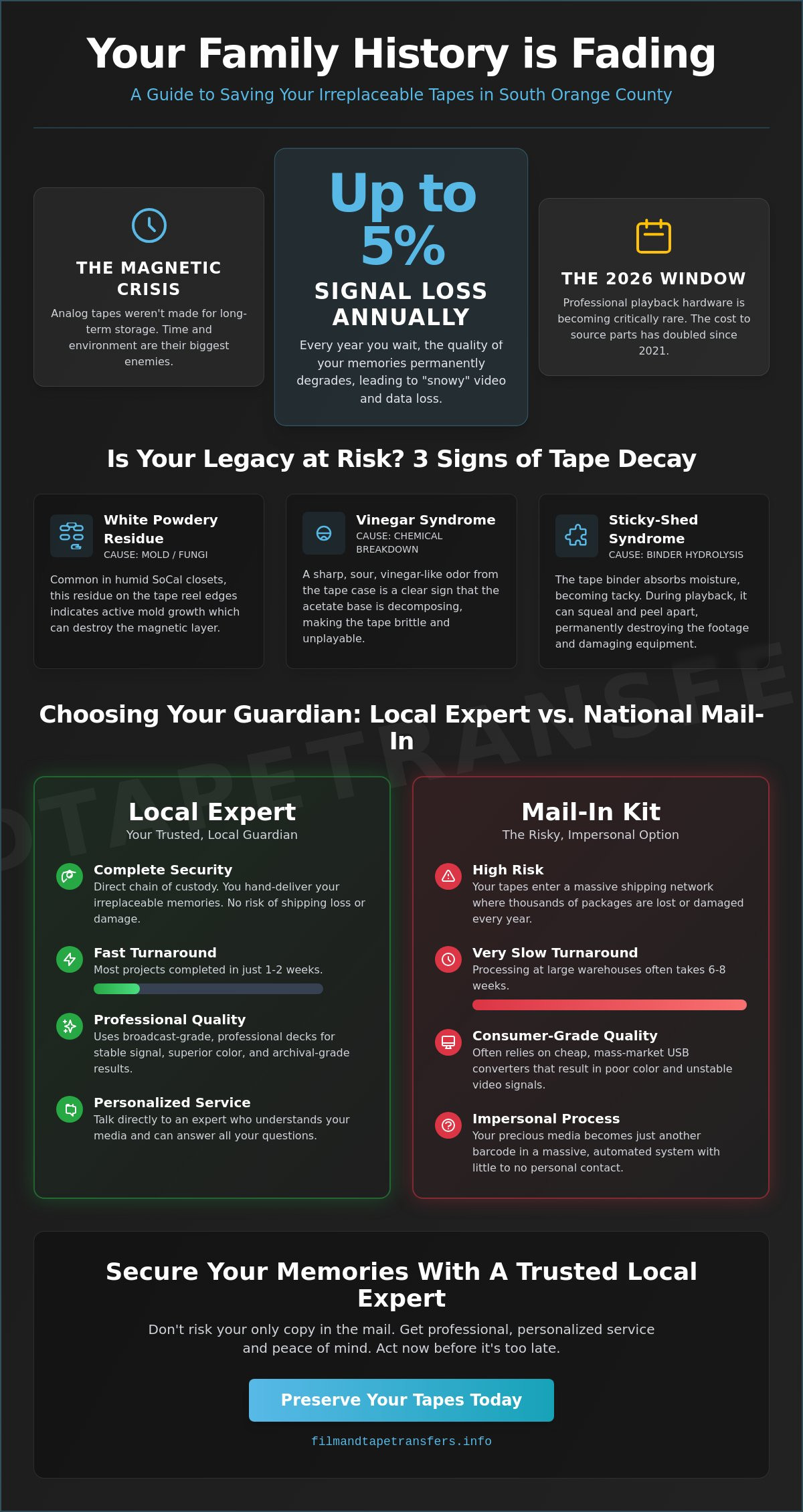
A tape digitizing service provides a vital bridge between the past and the present. It's the technical process of converting analog magnetic signals into modern digital video files, such as MP4 or MOV. This conversion is necessary because we're currently facing what archivists call the "Magnetic Crisis." Every year an analog tape sits unplayed in a box, it loses a portion of its data. Industry data suggests that magnetic media can lose up to 5% of its signal integrity annually, making the window for a successful transfer smaller every day.
Living in South Orange County presents unique environmental challenges for your media collection. In cities like Mission Viejo and Laguna Niguel, seasonal heat and coastal humidity create a perfect breeding ground for tape mold. If you store your tapes in a garage or attic, these temperature swings accelerate the chemical breakdown of the binder that holds magnetic particles to the plastic ribbon. Reviewing the history of videotape formats reveals that these materials were designed for temporary convenience, not 50 year storage. Whether it's a 1992 Irvine youth soccer championship or a 1985 wedding at a Dana Point resort, these local memories are physically fading.
Signs Your Tapes Are Degrading
You can often identify physical decay before you even attempt playback. Look for these three specific indicators of failure:
- White powdery residue: This is active mold or fungi growth on the edges of the tape reel. It's common in tapes stored in humid Southern California closets.
- Vinegar Syndrome: A sharp, sour odor coming from the tape case indicates the acetate base is undergoing a chemical breakdown.
- Sticky-shed syndrome: This happens when the binder absorbs moisture and becomes tacky. The tape may literally peel apart or "squeal" during playback, which can permanently destroy the footage.
The 2026 Window for Preservation
The year 2026 is a critical milestone for family historians. Professional-grade playback hardware, including high-end VCRs and camcorders, is becoming extremely rare and expensive to maintain. For older formats like Betamax, the cost of sourcing replacement parts for archival decks has nearly doubled since 2021. A primary technical concern is remanence. Remanence is the residual magnetism left in the magnetic oxide after an external magnetic field is removed; over several decades, this magnetism weakens, leading to "snowy" video and eventual total signal loss. Engaging a professional tape digitizing service this year is the only way to guarantee your family's legacy remains viewable on modern devices.
Comparing Tape Digitizing Service Options: Local Experts vs. Mail-In Kits
Choosing how to preserve your family films involves weighing convenience against the safety of your memories. A local tape digitizing service offers a level of security that national mail-in kits simply cannot match. When you drop off your tapes in Aliso Viejo or Laguna Hills, you maintain a direct chain of custody. Your irreplaceable media never enters a massive shipping network where it could be lost or damaged. Most local projects are completed within 1 to 2 weeks, while large mail-in warehouses often require 6 to 8 weeks for processing.
Quality also varies significantly between these options. Local specialists use professional, broadcast-grade decks rather than the cheap consumer-level USB converters found in many DIY kits. These professional machines ensure a stable signal and better color reproduction for your home movies. If you have questions about your specific collection, you can talk to a local expert who understands the nuances of your media and provides a personalized touch that mass-market warehouses lack.
The Risks of Shipping Irreplaceable Media
Sending your only copy of a child's birth or a 1980s wedding through a national carrier involves inherent risks. While shipping companies provide tracking numbers, a digital code cannot replace a physical tape if it's crushed or misrouted. National carriers handle millions of packages daily; even a tiny error rate means thousands of items are lost or damaged every year. Hand-delivering your memories to a trusted guardian in San Clemente provides a level of peace of mind that no shipping insurance can buy. Your media stays in safe, professional hands from the moment you drop it off until you pick it up.
Archival Quality Standards
True preservation requires technical precision. The Canadian Conservation Institute guide emphasizes that proper digitization must account for the specific characteristics of analog signals. For example, capturing VHS at its native 480i resolution is critical to maintaining the original look of the footage. Professional services also utilize Time-Base Correctors (TBC) to stabilize shaky video signals before they're converted. This technical step is vital for older tapes that have begun to stretch or degrade. You can choose between MP4 files for easy sharing on social media or high-bitrate ProRes files if you plan to edit your footage into a family documentary later.
Identifying Your Media: A Guide for Aliso Viejo and Irvine Households
Many families in Aliso Viejo and Irvine find themselves staring at a box of mixed media without knowing where to start. Before you contact a tape digitizing service, it's helpful to know exactly what you have. Most home movie collections from the 1980s through the early 2000s consist of five or six main formats. Performing a simple "size test" is the easiest way to categorize them. Full-size VHS tapes are the largest, measuring roughly 7.4 by 4 inches. If the tape is smaller, it likely belongs to a camcorder format like Hi8 or MiniDV.
Inventory management is a key step in preserving your legacy. To get an accurate quote, count each individual plastic housing as one unit. Don't forget to look for audio formats. Many shoeboxes in South Orange County contain compact audio cassettes or 1/4 inch reel-to-reel tapes alongside video footage. Identifying these items now ensures a smoother tape digitizing service experience and helps you organize your digital library later.
Common Video Tape Formats
- VHS and S-VHS: These are the standard "bricks" used in home VCRs. They're roughly the size of a paperback book and were the most popular format for movies and home recordings throughout the 80s and 90s.
- The 8mm Family: This group includes Video8, Hi8, and Digital8. While they look identical in size (about the size of a cassette tape), they represent different eras of camcorder technology. Look for the "Hi8" or "Digital8" logo on the tape door.
- MiniDV: These are the smallest tapes in most collections, measuring about 2.6 by 1.9 inches. They were the digital standard for high-end home camcorders in the early 2000s.
Specialty and Legacy Formats
You might encounter VHS-C tapes, which are compact versions of VHS. These were popular in the 1990s because they were small enough for handheld camcorders but could play in a standard VCR using a motorized "play-pak" adapter. Another common find in Laguna Woods collections is BetaMax. While slightly smaller and thicker than a VHS tape, BetaMax offered superior picture quality and was a favorite for early adopters of home video technology. MiniDV requires a bit-for-bit digital transfer process rather than the analog conversion used for VHS, as the footage is already stored as digital data on the magnetic ribbon.
Step-by-Step: How to Prepare Your Tapes for Professional Digitization
Before you bring your collection to a tape digitizing service, a few simple preparation steps ensure the best results. Start by inspecting the physical condition of each tape housing. Look for visible cracks in the plastic or reels that appear stuck. If you see the white powdery residue mentioned earlier, keep those tapes separate to prevent cross-contamination. Physically compromised tapes require specialized care to ensure they don't jam the professional playback decks during the transfer process.
Labeling is your next priority for a successful project. Use removable sticky notes or masking tape to number your items. This helps our technicians ensure your new digital files have the correct titles. If you have a large volume of media, prioritize your "must-save" moments first. Focus on irreplaceable events like 1980s weddings, first steps, or holiday gatherings. Finally, plan for safe transport. When driving your media to our South Orange County facility, never leave your tapes in a hot car. Even 15 minutes in the California sun can warp the magnetic ribbon and destroy your footage before it can be saved.
Organizing for the Future
Decide whether you want your digital library sorted chronologically or by event. Chronological sorting (e.g., "1994," "1995") is great for historical record-keeping. Event-based sorting (e.g., "Summer Vacations," "Birthday Parties") often makes it easier for family members to browse the files later. If you find a "mystery tape" with no label, don't worry. We can often help identify the content during the intake process. For those with a large number of standard cassettes, our professional VHS to digital transfer guide offers more specific tips on prepping that format.
Choosing Your Digital Destination
In 2026, you have several excellent options for storing your new digital files. USB flash drives remain the best choice for a physical backup that plugs directly into modern smart TVs. Cloud storage is the superior option for sharing memories with family members living in other states. While some people still request DVDs, we recommend MP4 digital files as the primary format. MP4 files offer better long-term compatibility and higher resolution than the aging DVD standard. Once your preparation is complete, request a quote for your project to start the preservation process.
Preserving Memories Locally: The Film and Tape Transfers Difference
Film and Tape Transfers has been a part of the South Orange County community for over 30 years. Our team understands that when you choose a tape digitizing service, you're looking for more than a technical transfer. You're looking for a careful steward of your personal history. We've spent three decades refining our "Trusted Guardian" approach. This means we never outsource your media to third-party labs or national warehouses. Every reel of film and every VHS cassette stays right here in our local facility. This eliminates the risk of loss or damage during transit.
Our expertise extends beyond simple conversion. Many collections we receive from local attics require mold remediation or physical tape repair before the digitization can begin. We handle these delicate materials with precision. We ensure that even damaged tapes have the best chance at a high-quality recovery. For residents in Laguna Woods, Irvine, and the surrounding areas, getting started is as simple as a local drop-off. You don't have to worry about finding the right box or printing shipping labels. You just bring your memories to us, and we handle the technical work.
Our Local South Orange County Service Area
We provide specialized archival services for families throughout Laguna Woods, Laguna Hills, Aliso Viejo, and Mission Viejo. Our central location offers convenient access for clients in Irvine, San Clemente, and Dana Point who prefer a face-to-face consultation. We also provide customized solutions for large bulk collections. Local historical societies often work with us because we offer strict chain-of-custody protocols for their sensitive archives. Whether you have five tapes or five hundred, we treat every project with the same level of professional care.
Beyond Tapes: A Full Preservation Suite
A complete family archive often includes more than just video footage. You can easily integrate your video transfers with our professional slide scanning service to bring your 35mm memories into the digital age. We also offer audio cassette conversion and high-resolution photo scanning to ensure every part of your legacy is protected. Our goal is to create a comprehensive digital library that your family can access on any modern device. Don't let your history fade away in a storage bin. Preserve your memories today with Film and Tape Transfers and ensure they're ready for the next generation to enjoy.
Secure Your Family Legacy for the Next Generation
Your memories are too precious to leave to chance. Magnetic tapes are physically degrading every year, and the equipment required to play them is becoming increasingly rare. Choosing a local tape digitizing service ensures your original media never leaves South Orange County. This removes the inherent risk of loss or damage found in national shipping networks. We've served as a trusted guardian for local families since 1990, providing specialized care for VHS, 8mm film, and 35mm slides.
By taking action now, you're transforming fragile plastic cassettes into vibrant digital files that your children and grandchildren can view on any modern device. Our team provides the technical precision needed to rescue your footage from the long-term effects of heat and humidity. We handle every step of the process right here in our local facility, from initial inspection to final file delivery. It's time to bring those old shoeboxes out of the dark and back into your life where they belong.
Preserve Your Family Memories Locally—Get a Quote Today
Your family history is a gift that deserves to be shared. We look forward to helping you protect these irreplaceable moments for years to come.
Frequently Asked Questions
How much does a tape digitizing service cost in South Orange County?
Pricing for media conversion depends on the format and the total number of items in your collection. As of April 2026, local providers like The Video Editor in Newport Beach offer conversion rates at $14.99 per tape after promotional discounts. Other providers like Capture SMC list a starting price of $17.94 per tape or device. Most specialists offer custom quotes for bulk orders containing multiple formats like VHS and 8mm film.
Can you digitize tapes that are moldy or broken?
Yes, professional technicians can often recover footage from media that has suffered physical damage or environmental decay. Mold remediation involves a specialized cleaning process to remove spores from the tape ribbon without damaging the magnetic signal. Broken shells can be replaced, and snapped tapes can be spliced back together. It is best to keep these items in a separate bag when you bring them in for evaluation.
What is the best digital format for my old home movies?
We recommend the MP4 format for most families because it offers the best balance of quality and compatibility. MP4 files play on almost every modern device, including smart TVs, tablets, and smartphones. If you plan to perform professional color grading or editing, we can provide high bitrate ProRes files. These larger files preserve more technical data but require significantly more storage space on your hard drive.
How long does it take to convert a box of VHS tapes to digital?
Most local projects in the Laguna Woods area are completed within 5 to 10 business days. While national mail in warehouses often have wait times of 6 to 8 weeks, a local tape digitizing service provides a much faster turnaround. The exact time depends on the size of your collection and whether any tapes require physical repair or mold cleaning before they can be safely played.
Is it better to get my tapes on a USB drive or in the cloud?
Using a combination of both is the safest way to protect your family legacy. A USB flash drive provides a physical backup that you can store locally and plug directly into your television. Cloud storage allows you to share memories instantly with family members across the country. Having your files in two different locations protects you against the failure of a single device or accidental loss.
Do I get my original tapes back after they are digitized?
Yes, we always return your original physical media along with your new digital files. We understand that these tapes are irreplaceable family artifacts that hold sentimental value. Even after the footage is safely transferred, we recommend keeping the originals in a climate controlled part of your home. This serves as a final analog backup for your most important family moments.
Can I watch my 8mm or Super 8 film reels before deciding to digitize them?
Viewing old film reels at home is risky because vintage projectors can easily tear brittle film or burn the frames. Most families find it safer to use a professional tape digitizing service to create a digital preview or index. This allows you to see what is on the reels without risking permanent damage to the physical film. Once digitized, you can easily organize and label your memories.
Why should I choose a local service over a national mail-in kit?
Local services offer a direct chain of custody that national shipping kits cannot provide. When you drop off your tapes in person, you know exactly who is handling your memories and where they are being stored. You avoid the risk of your only copy being lost or crushed in a massive shipping network. Our local experts provide personalized attention and can answer specific questions about your unique media collection.