


What is a Film Reel? A Preservation Guide for South Orange County Families
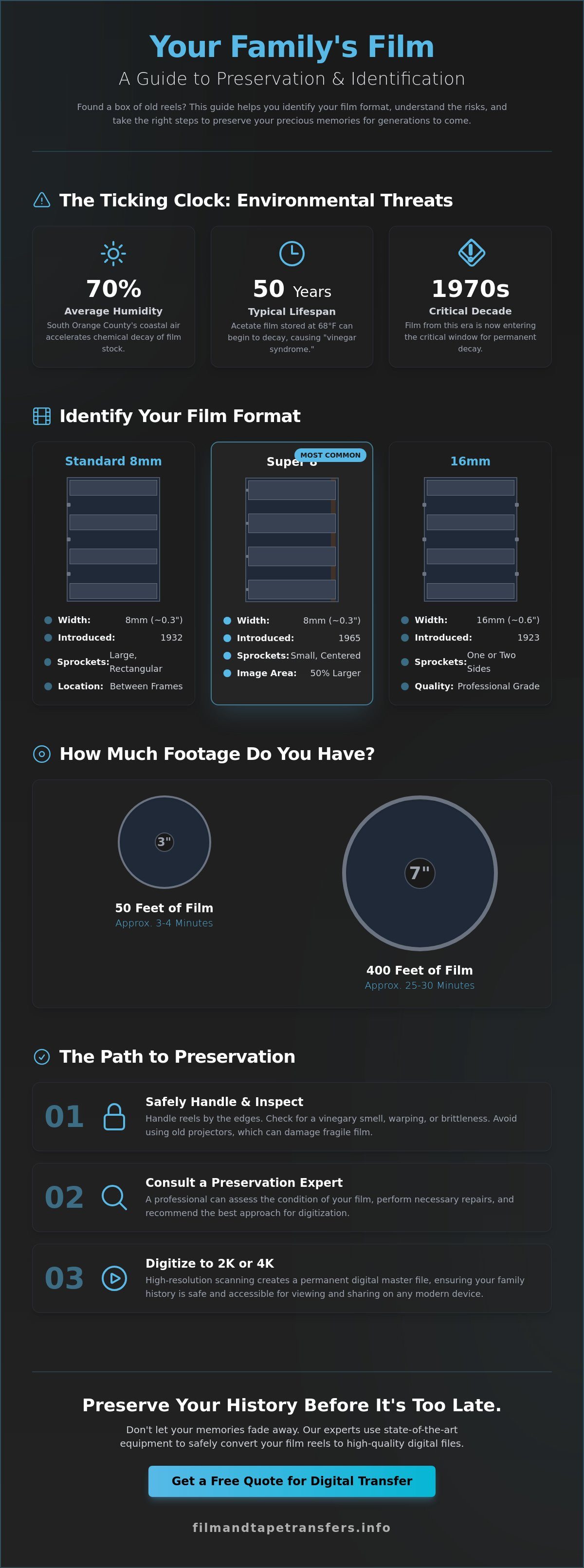
Every vintage film reel sitting in a South Orange County attic is a ticking clock. While these canisters hold your family’s most precious moments, the region's 70% average annual humidity is actively working against them. Acetate film stored at 68 degrees Fahrenheit typically begins to develop "vinegar syndrome" after just 50 years. If your reels haven't been opened since the 1970s, they are likely approaching a critical point of chemical decay.
It’s stressful to hold a piece of history and feel like you might break it just by looking at it. You probably recognize the sound of a projector but don't have a working one to see if the footage is still there. This guide will show you how to identify your film format, whether it's 8mm or 16mm, and how to spot the early warning signs of permanent damage. You'll learn the best ways to handle these delicate items and where to find a trusted South Orange County expert to help you move those memories safely into the digital age.
Key Takeaways
- Learn to distinguish between the physical storage reel and the actual film media to better understand your collection's needs.
- Identify your specific film format, such as 8mm or 16mm, by following our simple measurement guide.
- Discover how the coastal air in San Clemente and Dana Point impacts the longevity of your vintage recordings.
- Master the proper techniques for handling and inspecting delicate canisters without causing accidental damage.
- Understand the benefits of 2K and 4K scanning as the final step in ensuring your family history remains accessible.
What is a Film Reel? Understanding Your Legacy in South Orange County
A film reel is the physical housing for your family’s recorded history. In the simplest terms, it is a circular spool designed to hold a length of cinematographic film. For many families in Laguna Woods or Mission Viejo, these objects are often found tucked away in shoeboxes or metal canisters. While the reel itself is just a delivery system, it represents a specific era of storytelling that lasted from the early 20th century until the digital revolution of the late 1990s. It’s the physical bridge to a time before smartphones, when capturing a birthday or a holiday required a projector and a darkened living room.
It’s helpful to distinguish between the reel and the film. The reel is the hardware, the protective frame that keeps the media organized. The film is the actual "software" or the strip of images. To understand the chemistry of the media itself, you can research What is Film Stock? to see how light is captured on acetate. In the 21st century, these physical formats have become obsolete for viewing, yet their emotional value has only increased as the footage they contain grows older and more fragile.
The Anatomy of a Vintage Reel
Every vintage reel has a specific design intended to protect the delicate contents within. The most visible part is the flange. These are the two outer plates that prevent the edges of your film from light exposure, dust, and physical bending. If a flange is warped, it can scratch the film as it unwinds. At the center of the reel is the core. This is the mounting point where the film attaches to the spool. The shape of the core's hole often tells you if the film was meant for a specific type of projector.
Materials offer a clue to the age of your collection. Metal reels were the standard from the 1930s through the 1950s. They are durable but can rust if stored in the high humidity common near Dana Point. Plastic reels became popular in the 1960s and 1970s. While they don't rust, plastic can become brittle and crack over time. Identifying these materials is the first step in assessing the overall health of your archives.
Spool vs. Reel: What is the Difference?
Technically, a camera spool is the smaller hub used inside the camera to hold unexposed film, while a storage reel is the larger unit used for long-term keeping and projection. Most families use the word "reel" as a colloquial term for any movie they find in their collection. This is a natural part of the nostalgia surrounding home movies. The size of the container provides a direct estimate of how much footage you have. For example, a 3-inch diameter unit typically holds 50 feet of film, which translates to about 3 or 4 minutes of memories. A larger 7-inch unit can hold up to 400 feet, providing nearly 30 minutes of continuous footage.
Comparing 8mm, Super 8, and 16mm Reels: A Technical Guide
Identifying the specific format of your family's footage is the next step in the preservation process. The evolution of home movies moved from professional grade equipment to consumer friendly formats over several decades. In 1923, Kodak introduced 16mm film as a safer alternative to the flammable nitrate used in cinemas. By 1932, the more affordable 8mm format arrived, allowing families in Mission Viejo to document their daily lives. Understanding which reel you hold depends on measuring the width of the film strip and observing the shape of the sprocket holes.
To determine your format at home, use a ruler to measure the width of the film. 8mm and Super 8 are approximately 0.3 inches wide, while 16mm is double that size at roughly 0.6 inches. The sprocket holes, or perforations, serve as the most reliable visual identifier. For a technical look at these variations, the University of Illinois offers a Film Identification and Preservation Guide that details the physical characteristics of each type. These holes are what the projector used to pull the film through the gate, and they dictate the type of equipment needed for transfer.
Standard 8mm vs. Super 8 Film
Standard 8mm (often called Regular 8) and Super 8 might look similar, but they are not interchangeable. Super 8 was introduced in 1965 and was essentially the "HD" of its time. It featured a 50% larger image area than Standard 8mm because its sprocket holes were smaller and moved to the center of the frame. This change allowed more room for the picture. If you look closely at your Super 8 reels, you might notice a thin, rust colored "Z-strip" or magnetic band along the edge. This indicates the film contains sound, a feature that became common for high end home movies in the 1970s.
16mm Reels: The Professional Standard
While 8mm was for casual backyard clips, 16mm was the choice for significant events like weddings or professional documentaries. These reels are much larger and heavier. You can identify 16mm by looking at the perforations. Double-perf film has holes on both sides, while single-perf only has them on one side to make room for an audio track. Because of the higher resolution, these films often yield stunning results when digitized. If you're ready to see what's on your smaller formats, you can explore our 8mm film scanning resource for specific preservation tips. It's often best to let a trusted local specialist handle the identification to ensure no damage occurs to your reel during the inspection.
The Risks of Storage: Why South Orange County Humidity Threatens Your Reels
Families in San Clemente and Dana Point face a unique challenge when it comes to preserving their history. The coastal air is beautiful, but it's heavy with moisture. The average annual relative humidity in our region stays around 70%. This is significantly higher than the 30% to 50% range recommended in the Library of Congress film preservation guide. High humidity triggers a destructive chemical reaction in acetate film, leading to rapid oxidation and decay that can't be reversed once it starts.
Many Irvine residents store old boxes in the garage, thinking they are safe. This is often the worst choice for long-term survival. Garages lack climate control and expose your media to extreme temperature swings. These conditions cause the film base to shrink and the image emulsion to flake off like dry paint. Once the emulsion separates from the base, the images are gone forever. Storing a reel in a hot, damp environment is essentially putting a countdown timer on your family’s most precious memories.
Identifying Vinegar Syndrome
If you open a film canister and notice a sharp, sour odor, you've encountered "Vinegar Syndrome." This is the smell of acetic acid. It indicates that the reel is chemically breaking down from the inside out. You must act quickly to save the footage. Vinegar syndrome is contagious between reels. If one film in a box is "sick," the acidic gases it releases will infect every other film stored nearby. You should isolate any smelling film immediately to protect the rest of your collection from the same fate.
Mold and Salt Air Damage
Humidity doesn't just cause chemical decay; it also invites biological growth. Mold often appears as fuzzy, white spider-web patterns across the surface of the film. In our coastal towns, salt air adds another layer of risk. Salt accelerates rust on vintage metal containers. This rust creates jagged, abrasive edges that can shred your film during playback or scanning. Residents in Aliso Viejo should check their storage units or closets at least once every twelve months. Look for white powder, rust spots, or a sticky residue on the canisters. Catching these early warning signs is the only way to ensure your footage remains viable for a high quality digital transfer.
How to Safely Handle and Inspect Your Vintage Reels at Home
Inspecting your family collection requires a delicate touch and a controlled environment. Before you open a canister, ensure your workspace is clean and free of food or liquids. Your skin produces natural oils that can leave permanent fingerprints on the film emulsion, attracting dust and promoting mold growth. Use clean, dry hands or, ideally, white cotton gloves designed for archival handling. If you find a reel where the film layers seem fused together, stop immediately. Never force the film to unwind. Forcing a stuck strip can cause the emulsion to rip away from the base, resulting in a total loss of the image.
A common mistake is attempting to view footage using a vintage projector found in a Laguna Hills garage. Most of these machines haven't been serviced in 30 years. The rubber belts may have turned to goo, and the internal gears often seize. Running brittle, 50 year old film through an unserviced projector is the fastest way to shred the sprocket holes or burn a hole through the frame with the high heat of the projection lamp. Instead, use a magnifying glass to inspect the "leader," which is the blank strip of film at the very beginning of the reel.
Step-by-Step Visual Inspection
- Identify Cupping: Hold the film up to the light and look for "cupping," where the edges curve toward the center like a straw. This indicates significant shrinkage.
- Check Sprocket Holes: Look for jagged or torn perforations. If these are damaged, the film won't track correctly through a professional scanner without repair.
- Document Metadata: Note any dates, names, or locations written on the reel flanges or the storage box. This information is vital for organizing your digital library later.
Safe Cleaning Practices
Removing surface dust is a critical step before any transfer process. Use a canister of moisture-free canned air held at a safe distance to blow away loose particles. Avoid using microfiber cloths or paper towels, as these can trap grit and create long, linear scratches across your memories. You should never apply household chemicals, window cleaners, or alcohols to the film surface. These substances can dissolve the binder holding the image to the plastic. If you encounter sticky residue or heavy mold, it's time to consult a professional film preservationist in South Orange County. We have the specialized solvents and ultrasonic cleaners necessary to stabilize your media without causing further harm.
Preserving Your Memories: Moving from Physical Reels to Digital Files
The chemical decay discussed in previous sections is a relentless process. While proper storage slows the degradation, digitization is the only way to effectively "stop the clock." Every vintage reel in your collection is an analog format, meaning the physical material itself holds the image. When you convert these strips to digital files, you transfer that visual information into a format that doesn't age, fade, or smell of vinegar. This transition ensures that your family history remains accessible for the next 100 years and beyond.
Modern scanning technology offers a level of clarity that was impossible to achieve with home projectors in the 1970s. We utilize 2K and 4K high-definition scanning to capture the full detail of 8mm and Super 8 film. These high resolutions are essential because they provide enough data for modern large-screen televisions. Once the footage is digital, it's effortless to share. Instead of one person holding the physical canisters, every family member in South Orange County can have their own copy on a USB drive or via cloud storage. This redundancy is the ultimate form of "preserving memories."
The Digitization Process
Professional transfer services have moved far beyond the old "projection" methods where a camera simply recorded a screen. Today, we use frame-by-frame scanning. This process treats every single frame of your reel as an individual high-resolution photograph. This technique eliminates the flicker often seen in older transfers and allows for precise speed adjustments. For families interested in the specific technical requirements of high-end capture, our guide on super 8 film scanning provides a deeper look. Film and Tape Transfers also includes color correction to restore the vibrant hues that may have shifted toward red or blue over decades of storage.
Why Local Service Matters in Laguna Woods
Handing over irreplaceable memories is an act of trust. Many national services require you to ship your only copy of a film or a set of 35mm slides across the country. This exposes your history to the risks of transit damage or loss. By choosing a local South Orange County expert, you eliminate that anxiety. You can speak directly with the technician who will be handling your media, ensuring that specific instructions are followed. We act as a dependable steward of your past, providing the precision and care that mass-market operations often lack. Preserve your family reels today with Film and Tape Transfers and ensure your legacy is never lost to time.
Secure Your Family Legacy Today
Understanding the anatomy and format of your vintage reel is the first step toward saving your family's history. You now know how to identify 8mm and 16mm film, recognize the warning signs of vinegar syndrome, and handle brittle strips with the care they deserve. The high humidity in San Clemente and Irvine makes this a time-sensitive task. Waiting another decade could mean the difference between a clear digital transfer and permanent image loss. Don't let your irreplaceable stories fade away in a garage or attic.
Film and Tape Transfers has been locally owned and operated since 1990. We specialize in the high-resolution preservation of 8mm, Super 8, and 16mm formats. Our team has been trusted by Laguna Woods and Irvine families for over 30 years to act as the careful guardians of their personal archives. We provide the technical expertise and nostalgic care needed to move your analog memories safely into the digital world. Preserve your South Orange County memories with our expert film transfer services. We look forward to helping you share your history with the next generation.
Frequently Asked Questions
How can I tell if my film reel is 8mm or Super 8?
You can identify the format by looking at the center mounting hole of the reel. Standard 8mm film has a small center hole measuring approximately 8mm in diameter. Super 8 film features a much larger center hole that is roughly 13mm across. Additionally, Super 8 film has smaller sprocket holes located in the middle of each frame, whereas Standard 8mm has larger, rectangular holes aligned with the frame lines.
Is it safe to watch my old reels on a projector I found at a thrift store?
It is generally unsafe to run vintage film through an unserviced thrift store projector. These machines often have dried lubricants or degraded rubber belts that can seize during operation. If the projector stops while the high-heat lamp is on, it will melt through your film in less than two seconds. Brittle acetate film is also likely to snap or experience sprocket damage when handled by old, uncalibrated mechanical parts.
What does it mean if my film reels smell like vinegar?
A vinegar scent indicates that your film is suffering from "Vinegar Syndrome," a form of chemical decay. This occurs when the acetate base of the film begins to break down and release acetic acid. This process is irreversible and accelerates in the high humidity common in coastal South Orange County. You should isolate any smelling film immediately, as the acidic gases can trigger decay in healthy reels stored nearby.
How long does a 3-inch film reel actually play for?
A standard 3-inch reel typically contains 50 feet of film and provides about 3 to 4 minutes of footage. The exact runtime depends on the speed at which the film was recorded. Most home movies were shot at 16 or 18 frames per second. If you have a larger 7-inch container, that usually holds 400 feet of film, which results in approximately 28 to 30 minutes of continuous family memories.
Can you digitize a reel that has been damaged by mold or water?
Yes, we can often recover footage from reels with moderate mold or water damage through professional cleaning. Mold often appears as white, spider-web patterns that we remove using specialized archival solvents before scanning. Water damage can cause the film layers to stick together, a condition known as "blocking." These cases require a careful stabilization process to ensure the emulsion doesn't rip away from the base during the transfer.
Where can I get my film reels converted to digital in Mission Viejo?
Film and Tape Transfers provides local digitization services for families in Mission Viejo and throughout South Orange County. Our facility is located nearby, allowing you to drop off your films in person rather than risking them in the mail. We have served the local community for over 30 years, specializing in 8mm, Super 8, and 16mm film scanning using professional frame-by-frame technology.
Is color film more likely to fade than black and white reels?
Color film is significantly more susceptible to fading because it relies on organic dyes that break down over time. Most color home movies from the 1950s and 1960s will eventually shift toward a reddish or magenta hue. Black and white film uses silver halides, which are much more stable. In archival conditions, black and white footage can remain clear for over 100 years, while color film often shows noticeable degradation within 40 years.
What is the best way to store my reels until I can get them scanned?
The best storage location is a cool, dark closet inside the main living area of your home. You must avoid garages, attics, or sheds where temperature and humidity fluctuations are extreme. Aim for a consistent temperature below 70 degrees Fahrenheit and keep the films away from exterior walls. This stable environment helps slow the chemical breakdown and preserves the image quality until you can complete a professional digital transfer.