


Best Photo Scanning in Laguna Woods: Your 2026 Guide to Preserving Memories
Imagine opening a weathered shoebox in your Laguna Woods home and finding a 50 year old wedding photo that is starting to fade. You know these physical copies won't last forever, yet the thought of handing them over to a stranger feels risky. Finding the best photo scanning Laguna Woods offers is about more than just clicking a button. It's about choosing a partner who treats your history with the same care you do.
We agree that preserving your family legacy shouldn't be stressful or confusing. You shouldn't have to worry about technical terms like DPI or the fear of losing one-of-a-kind originals. This guide helps you identify the essential criteria for professional digitization with archival precision. We'll explore local options like Pix & Dubs, which has handled over 500,000 scans since 2004, and show you how to secure high-resolution digital files while ensuring your physical media returns home safely. You'll learn exactly how to turn that dusty shoebox into a permanent, high-quality digital library for future generations.
Key Takeaways
- Learn how local climate factors like humidity accelerate the aging of physical prints and why professional digitization is the only way to stop the degradation clock.
- Identify the specific equipment and cleaning protocols that define the best photo scanning Laguna Woods has to offer for high-quality archival results.
- Simplify the technical confusion surrounding resolution by discovering why 600 DPI and specific file formats are essential for long-term digital preservation.
- Master a simple two-step process to sort your collection and safely remove photos from damaging magnetic albums before you begin the transfer.
- Understand the benefits of working with a local specialist who treats your family history as a unique piece of history rather than just another data point.
Why Laguna Woods Families Are Prioritizing Photo Digitization in 2026
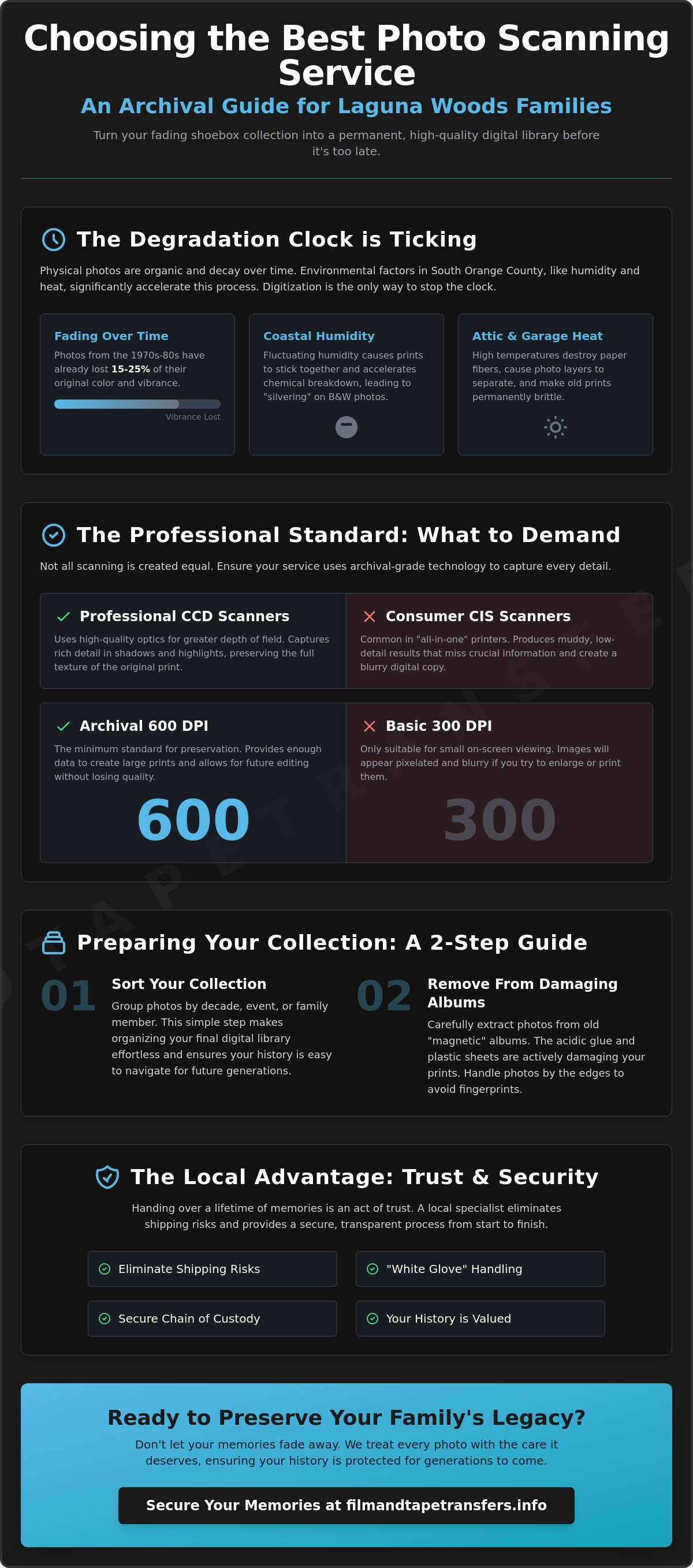
Every family collection has a "degradation clock" ticking in the background. Physical prints, negatives, and slides are organic materials. Over time, the chemical bonds that hold color and detail together begin to fail. By 2026, many photos from the 1970s and 1980s have already lost 15% to 25% of their original vibrance. This silent decay makes finding the best photo scanning Laguna Woods offers a matter of urgency. It's not just a weekend project; it's a rescue mission for your personal history.
Laguna Woods residents face specific environmental challenges that speed up this process. South Orange County experiences significant temperature swings throughout the year. Humidity levels near the coast can fluctuate by 30% or more in a single day. These conditions accelerate the "silvering" effect on black and white prints and cause color slides to develop a distinct magenta tint. Understanding how image scanners work helps clarify why professional grade equipment is necessary. We use high resolution sensors to pull every possible bit of information from the original media before the chemical breakdown becomes irreversible.
The Risks of Physical Storage in South Orange County
Storing treasures in a garage or attic is essentially placing them in a "danger zone." These spaces trap heat, which destroys paper fibers and causes emulsion to stick together. Common signs of decay include brittle edges and fading where light and heat strip away yellow and cyan dyes first. If you notice a metallic sheen on the dark areas of your old prints, that's silvering. It's a clear signal that the photo is breaking down. Act-now preservation is vital. Once the layers of a photo separate or the colors vanish completely, even the most advanced digital restoration can't bring them back.
The Digital Advantage for Family Legacies
Digital files bridge the accessibility gap between generations. You can share a 1954 wedding album with family in Aliso Viejo or Mission Viejo instantly via the cloud. In 2026, the standard for a "trusted" service has shifted from simple backups to archival-grade preservation. This involves creating redundant copies on secure hard drives, USBs, and private cloud folders. A digital library also allows for precise organization. You can tag photos by decade, event, or family member. This turns a chaotic box of loose prints into a searchable, organized history that is easy to pass down. Film and Tape Transfers focuses on this transition, ensuring your memories are protected from physical loss and environmental damage.
How to Evaluate the Best Photo Scanning Services
Choosing the right partner for your project involves more than comparing price lists. The best photo scanning Laguna Woods offers is defined by technical precision and careful handling. You want to ensure the service uses professional-grade Charge-Coupled Device (CCD) scanners rather than standard consumer flatbeds. CCD sensors provide a greater depth of field. This allows the scanner to capture textures and details in the shadows that cheaper equipment simply misses.
Resolution is another critical factor. While 300 DPI is standard for basic viewing, archival-grade scanning requires at least 600 DPI for physical prints. This higher resolution ensures that you can enlarge the photo later without it becoming pixelated. A professional service should also include basic post-processing in their standard rate. This includes color correction to reverse the "degradation clock" mentioned earlier and manual dust removal to ensure a clean digital image.
Professional vs. Consumer Scanning Equipment
Many home offices have "all-in-one" printers. These devices often use Contact Image Sensors (CIS). While fine for documents, they produce muddy, low-detail results when used for photos. Dedicated professional scanners use high-quality glass optics and stable light sources. This combination maintains image sharpness across the entire print. It's the difference between a blurry snapshot and a crisp, clear preservation of a family memory. High-speed, dedicated scanners also ensure that the focus remains sharp from edge to edge, avoiding the distortion common in cheap hardware.
Safety and Chain of Custody
Handing over a lifetime of photos is an act of trust. You should always ask how your originals are tracked through the digitization process. Laguna Woods residents often prefer local providers because it eliminates the risk of a shipping carrier losing a box of irreplaceable memories. When your media stays in a local facility, the chain of custody is short and secure.
A "White Glove" treatment is essential for older collections. This means your photos are handled manually rather than being fed through an automated high-speed document feeder. Automated feeders can tear brittle edges or scratch delicate surfaces. Manual handling ensures that every 4x6 print or 35mm slide is treated with the respect it deserves. If you are ready to move your collection from a shoebox to a secure digital format, you can explore professional scanning options that prioritize security and quality. This careful approach ensures your physical originals return home in the same condition they arrived.
Digital Formats and Resolution: What You Need to Know
Technical specifications shouldn't be a barrier to preserving your history. When searching for the best photo scanning Laguna Woods has to offer, you'll encounter terms like DPI and bit-depth. These aren't just industry jargon; they dictate whether your digital files will look good on a 65 inch television or just a small smartphone screen. Resolution is the foundation of a quality scan. For a standard 4x6 print, 600 DPI is the sweet spot. It captures every detail of the original paper grain while allowing you to double the size of the image without losing clarity.
Color depth is equally important for a natural look. Most consumer scans use 24-bit color. Professional archival services often utilize 48-bit scanning. This captures billions of more color shades, which is vital for vivid memory restoration. It gives the software more data to work with when correcting that magenta tint caused by Orange County humidity. Once the process is complete, we provide options for file delivery. Many Laguna Woods families choose a physical USB drive for a tangible backup. Others prefer secure cloud links for instant sharing with relatives in nearby Aliso Viejo. We recommend a combination of both to ensure your digital library is resilient.
Choosing the Right Resolution for Your Project
Standard scanning at 300 to 600 DPI is ideal for viewing on tablets and computers. It's the most common choice for large family collections. However, archival scanning at 1200 DPI or higher is necessary if you plan to blow up small photos into large wall prints. It's worth noting that 35mm slide scanning requires significantly higher DPI than print scanning. Because a slide is only about one inch wide, it must be scanned at a much higher density to produce a clear image when projected onto a modern screen.
File Formats for Longevity
The choice between JPEG and TIFF depends on your goals. JPEG is the universal standard. It's perfect for easy sharing, social media, and everyday viewing because the files are smaller. TIFF is the uncompressed "master file" for serious family historians. These files are much larger but contain every bit of data the scanner captured. They are the best choice if you plan to do professional photo restoration later. We help you organize these files into logical folder structures. Using clear naming conventions based on dates or events makes your decades of history searchable and easy to navigate for future generations.
Preparing Your Photo Collection for Scanning
A lifetime of memories often sits in a disorganized pile. Preparing your collection is the most effective way to ensure the best photo scanning Laguna Woods provides results in a clear, easy to navigate digital library. The process begins with sorting. Grouping your photos by decade, specific family member, or major life event allows the scanning technician to mirror this structure in your digital folders. This organization saves hours of searching once you receive your files on a USB or via the cloud.
Identifying different media types is the next step. Keep your 4x6 prints, 35mm slides, and negatives in separate batches. Each of these requires different equipment and handling protocols. For basic cleaning, a soft bristled brush or a quick puff of compressed air is sufficient to remove surface dust. Avoid using any liquids or household cleaning cloths, as these can introduce moisture or micro scratches that are permanent. If you feel overwhelmed by the volume of your collection, remember that we are here to help you through every phase of the transfer.
The Trouble with Old Photo Albums
The "magnetic" or sticky albums popular in the 1970s are a significant risk factor for photo loss. The adhesive used in these books is often highly acidic. Over time, it can bond the photo to the page, making removal difficult. If a print feels stuck, don't force it. You can sometimes use a piece of thin dental floss to gently "saw" behind the photo and release the bond. In cases where the photos are too fragile to move, a professional service can scan the entire album page and then digitally crop the individual images. This protects the original while still achieving a high quality digital result.
Organizing for the Best Results
Practical tools like Ziploc bags or index cards are perfect for labeling your categories. Write the year or event on a card and place it at the front of each stack. This provides a clear roadmap for the scanning team. If you have fragile or torn photos, place them in a protective sleeve or a separate envelope and mark them for special care. Prioritizing your collection is also helpful. Start with your oldest memories or those showing the most significant signs of fading. When you are ready to begin, you can start your photo scanning project with our local team. We ensure that your physical originals are handled with archival precision and returned to you safely.
Why Film and Tape Transfers is the Trusted Choice for Laguna Woods
Handing over family history requires a partner who understands the weight of the materials. Film and Tape Transfers provides the best photo scanning Laguna Woods families have relied on for decades. We don't view your collection as a set of data points. We treat every print, negative, and slide as a unique piece of history. Our facility is designed for archival safety. This ensures that your originals are protected throughout the entire digitization process. Because we're a local business, your irreplaceable media never leaves our sight. You avoid the anxiety associated with national shipping hubs and automated processing centers.
Our comprehensive solutions allow you to consolidate your entire archive in one place. Many residents choose to combine their print projects with our professional slide scanning service. This creates a unified digital library where every format is preserved with the same high standards. We serve the Laguna Woods, Laguna Hills, and Aliso Viejo communities with a personalized touch. This local focus is why we remain the trusted choice for those who value security and precision above all else.
A Legacy of Preservation Since 1990
We've been dedicated to the South Orange County community since 1990. Our technicians are trained in specific archival standards rather than basic retail scanning. This expertise means we understand the chemical properties of different media types. We know how to handle brittle prints from the 1940s and faded slides from the 1960s. The "Film and Tape Transfers" promise is simple. Your memories stay safe and secure in our local facility. We take pride in being the trusted guardian of your personal history. This long standing commitment to quality has allowed us to serve thousands of local families over the last 36 years.
Beyond Photos: Your Full Media Preservation Partner
Preserving memories often involves more than just physical prints. You can combine your photo project with VHS to digital transfer to save those old home movies before they degrade. We also provide expert 8mm film scanning for movie reels found in attics or closets. Our team offers personalized consultations to help you plan your entire digitization journey. We help you prioritize which items need immediate attention. This holistic approach ensures that every part of your family legacy is captured for the future. Whether it's an audio cassette, a film reel, or a shoebox of photos, we provide a reliable path to permanent digital preservation.
Secure Your Legacy for Future Generations
The environmental risks in South Orange County mean that inaction is a choice to let your history fade. You now understand the technical standards required to protect your collection, from selecting 600 DPI resolution to choosing the right file formats for long-term storage. Finding the best photo scanning Laguna Woods provides is the final step in ensuring your children and grandchildren can experience these moments with perfect clarity. Moving your collection from a vulnerable shoebox to a secure digital archive stops the degradation clock permanently.
Film and Tape Transfers has been the trusted guardian of local history since 1990. Our archival-grade process and personalized local handling provide the peace of mind that mail-in services simply can't match. Your irreplaceable media stays safe in our hands while we transform it into a vibrant digital library. Don't wait until the chemical breakdown of your prints becomes irreversible. Preserve Your Laguna Woods Family History Today. We look forward to helping you protect your most cherished memories for the next 50 years and beyond.
Frequently Asked Questions
How much does photo scanning cost in Laguna Woods?
Specific pricing depends on the volume and condition of your media. As of May 2026, most local providers require a direct inquiry to provide an accurate quote. For example, Scan N More offers a free 10-minute consultation to assess your records and provide an estimate. Contacting a specialist directly ensures you receive a price tailored to your specific collection needs.
Do I need to take my photos out of the albums before bringing them in?
You don't need to remove photos if they are stuck in fragile "magnetic" albums from the 1970s. Forcing them out can cause irreversible paper tears. If your photos are loose, grouping them by decade or event helps the scanning process. Our technicians can scan full album pages and digitally crop individual images to protect your originals.
What is the best resolution (DPI) for scanning old family photos?
A resolution of 600 DPI is the professional standard for standard 4x6 prints. This provides enough detail for high-quality digital viewing and allows you to double the print size later. While 300 DPI is sufficient for basic screen viewing, 600 DPI ensures archival longevity. 35mm slides require much higher settings, often exceeding 2400 DPI, due to their small physical size.
Can you fix photos that are faded or have scratches?
Professional scanning services include basic digital restoration to reverse the effects of the degradation clock. We use specialized software to correct color shifts, such as the common magenta tint found in older slides. Manual dust removal and scratch reduction are also part of the process. This ensures your digital files look as close to the original moment as possible.
How long does it typically take to scan a large collection of photos?
Turnaround times generally range from 7 to 21 days depending on the size of your archive. Small batches of 50 to 100 photos are often completed faster. Larger family legacies involving thousands of prints or slides require more time for manual handling and quality checks. We prioritize precision over speed to ensure every memory is captured with archival accuracy.
Is it safer to use a local Laguna Woods area service than a mail-in service?
Using a local provider is significantly safer because it eliminates the risk of loss or damage during shipping. The best photo scanning Laguna Woods residents choose involves a short chain of custody where your media never leaves the facility. Mail-in services rely on third-party carriers, which adds a layer of anxiety when handling one-of-a-kind family originals.
What digital format should I choose: JPEG or TIFF?
JPEG is the ideal choice for most families because it's easy to share via email or social media. If you are a serious family historian, you might request TIFF files as your uncompressed master archive. TIFF files are much larger but preserve every detail for future professional editing. Most clients find that high-quality JPEGs offer the perfect balance of convenience and clarity.
Can you scan 35mm slides and negatives as well as prints?
Yes, we scan physical prints, 35mm slides, and film negatives using dedicated archival equipment. Each media type requires a specific technical approach to ensure the best results. Slides and negatives often hold more detail than paper prints, so we use high-resolution sensors to capture that extra depth. This allows you to view those old movie-night slides on modern high-definition screens.