


Local Film Digitization Service Mission Viejo: Preserving Your Legacy in 2026
Imagine opening a dusty box of 8mm reels in your Mission Viejo home, only to notice a sharp, vinegar-like odor. This scent is a warning sign of Cellulose Triacetate Degradation, a condition that makes film brittle and eventually unwatchable. You know these tapes and reels hold your only copies of your parents' wedding or your own first steps, but the thought of mailing them to a massive out-of-state warehouse feels too risky. Choosing a local film digitization service Mission Viejo families can visit in person eliminates that anxiety and ensures your history stays within reach.
It's natural to feel protective of your family's history and confused by technical terms like "MiniDV" or "Hi8." You deserve a "concierge" experience where you can speak to a technician who treats your media as a treasure, not just another barcode. This article explains how to preserve your legacy in 2026 with high-quality transfers starting as low as $13.49 for a three-inch reel. We'll cover the benefits of in-house scanning, the reality of film decay in Orange County, and why local experts like DVD Your Memories provide the security and archival precision your memories require.
Key Takeaways
- Learn why the local climate makes digitizing your analog media a priority to prevent irreversible chemical degradation.
- Explore the technical benefits of high-resolution, frame-by-frame scanning for 8mm and Super 8 film reels.
- Discover why a local film digitization service Mission Viejo families trust offers better security and care than national mail-in factories.
- Follow a simple two-step preparation guide to organize your tapes and film boxes before your professional transfer.
- Find out how specialized services for slides and photos can help you complete your family's digital archive.
Why Mission Viejo Families Need Local Film Digitization in 2026
Local film digitization is the professional process of converting aging analog reels and magnetic tapes into high-resolution digital files. For residents of South Orange County, finding a local film digitization service Mission Viejo can trust is no longer just a convenience; it's a necessity for preserving family history. These physical formats were never meant to last forever. Without professional intervention, the sounds and images of the past will eventually disappear as the materials they are recorded on succumb to time and environmental stress.
Mission Viejo's environment presents unique challenges for archival storage. While our Mediterranean climate feels pleasant, the fluctuating humidity levels near the coast and the seasonal heat of the Saddleback Valley can accelerate the chemical breakdown of old media. This environment is particularly dangerous for 8mm and 16mm film reels. These materials often suffer from "Vinegar Syndrome," which is the chemical breakdown of the acetate film base that releases acetic acid. This is a progressive condition that eventually makes the film too brittle to handle. Understanding the history of film preservation shows that once this process starts, professional scanning is the only way to save the footage before it's lost forever. Choosing a local film digitization service Mission Viejo expert ensures your one-of-a-kind archives are handled with the care they deserve right here in our community.
The Silent Deterioration of Analog Media
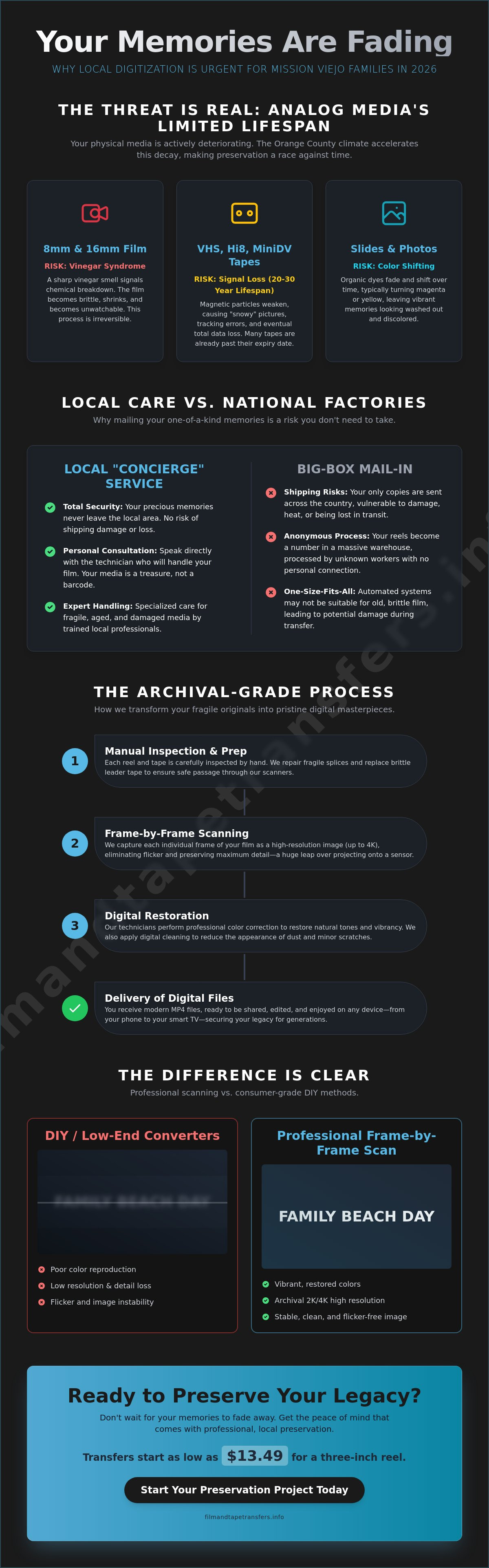
Most VHS and Hi8 magnetic tapes were designed with a lifespan of roughly 20 to 30 years. By 2026, many of these tapes have already reached their functional expiration date. The magnetic particles on the tape lose their charge over time, leading to "snow," tracking errors, or complete signal loss. Similarly, 35mm slides aren't immune to age. The organic dyes used in mid-century photography often shift toward magenta or yellow. This causes your vibrant memories to look washed out or discolored. Vinegar Syndrome is the chemical breakdown of the acetate film base that leads to shrinkage and brittleness.
The Emotional Value of Preservation
Digitizing your archive does more than just save data; it reconnects generations. Modern MP4 files allow you to share a grandfather’s childhood home or a parent’s graduation instantly via cloud storage or social media. While some attempt DIY transfers with cheap USB converters, these consumer tools often fail to capture the full color depth and clarity of the original media. Professional scanning utilizes high-end sensors to restore the vibrancy and detail that consumer equipment simply misses. This results in a digital file that looks as close to the original "first day" of filming as possible.
Expert 8mm and Super 8 Film Scanning: The Technical Process
The quality of your digital memories depends entirely on the technology used during the transfer. A professional local film digitization service Mission Viejo families rely on uses frame-by-frame scanning to ensure every detail is preserved. Unlike older methods that simply record a projection, this modern approach treats your film like a series of high-resolution photographs. This process is essential for 8mm film scanning, where the small frame size requires extreme precision to capture clear images. By 2026, the standard for archival quality has moved toward 2K and 4K resolutions. These higher bit rates allow the scanner to capture the actual grain of the film, providing a depth and texture that standard definition simply cannot match.
Before the scanning begins, a technician performs a manual inspection of your reels. They look for fragile splices that have dried out over the last 50 years and replace brittle leader tape. This preparation phase is critical for the safety of your media. Professional scanning also includes digital color correction. This step balances the color shifts that occur as film ages, restoring the natural skin tones and vibrant backgrounds of your original footage. Digital dust removal further cleans the image by reducing the appearance of small scratches and debris that have settled on the film surface over decades. If you want to ensure your history is handled with this level of care, you can start your preservation project today with a local expert.
Frame-by-Frame vs. Real-Time Capture
Older "real-time" capture methods often resulted in a distracting flicker. This happened because the frame rate of the projector didn't match the camera recording it. Modern frame-by-frame scanning eliminates this issue by taking a discrete image of each individual frame. Technicians use cool LED light sources during this process. These lights provide consistent illumination without the high heat of traditional bulbs, which could easily melt or burn fragile acetate. This method ensures edge-to-edge clarity for both Super 8 and standard 8mm formats, capturing details that were previously hidden in the shadows or corners of the frame.
Digital Output Formats for 2026
While DVDs were the standard for years, 2026 has seen a major shift toward versatile digital files. Most families now prefer high-quality MP4 or MOV files delivered on a USB drive. These formats are easy to watch on smart TVs and simple to share with relatives across Mission Viejo via cloud storage. For those who enjoy video editing, receiving archival master files provides the highest possible bit rate for future projects. Using a local film digitization service Mission Viejo allows you to discuss these format options in person, ensuring you receive exactly what you need for your family's specific viewing habits.
Local Service vs. Big-Box Mail-In: Protecting Your Reels
The primary concern for most family historians is the physical safety of their original media. Entrusting a lifetime of memories to a national shipping carrier involves a level of risk that many are unwilling to take. A local film digitization service Mission Viejo families can visit in person eliminates the uncertainty of the postal system entirely. When you drop off your media at a local office, you remove the possibility of your only copy of a 1960s wedding reel being lost in a sorting facility or damaged during out-of-state transit. Your history stays within your reach, providing a level of security that mail-in services simply cannot offer.
National brands typically operate as high-volume factories. In these facilities, your family's legacy is often treated as just another barcode in a system that processes thousands of orders every day. This "hands-off" approach can lead to a lack of detail in the final product. In contrast, a local boutique service focuses on precision and archival quality. Because the work is done in-house, the turnaround time is often significantly faster. While large-scale mail-in factories may take 6 to 12 weeks to return your project, local Mission Viejo drop-offs are typically completed in a fraction of that time. This efficiency doesn't sacrifice quality; it reflects a more focused and dedicated workflow.
The Risks of Shipping Irreplaceable Media
In 2026, logistics hurdles and shipping delays remain a common reality for national retailers. Statistics from major carriers show that while most packages arrive safely, the small percentage of lost or damaged items is a risk too great for one-of-a-kind film. Large-scale digitization factories rely on automated assembly lines to keep costs down. This environment isn't ideal for fragile 8mm or Super 8 film that may require manual repair. Local drop-off provides peace of mind for South Orange County residents because your media never leaves the hands of the experts you met at the counter.
Personalized Service and Technical Consultations
Working with a local expert allows for a "trusted guardian" relationship that a national warehouse can't replicate. You have the opportunity to speak directly with the technician who will perform your 8mm film scanning or photo conversion. This allows you to review specific reels or tapes before the full conversion begins. You can discuss custom digital outputs, such as high-bitrate MOV files for editing or compressed MP4s for easy sharing. Whether you're bringing in a single 3-inch reel or a massive collection of 7-inch reels, you receive a personalized technical consultation. This local accountability ensures that the final digital files meet your exact expectations for clarity and color accuracy.
Preparing Your Film and Tapes for Local Transfer
Taking the first step to preserve your family's history requires a small amount of preparation to ensure the best results. Before you visit a local film digitization service Mission Viejo families trust, you should perform a basic physical inspection of your collection. Check for visible white spots on tapes or a fine dust on film reels; these are often signs of mold or heavy debris. While professional cleaners can handle many issues, knowing the condition of your media helps the technician provide a more accurate assessment. Once inspected, label your boxes or tape shells in chronological order. This simple step ensures the digital files are organized in a way that makes sense when you finally share them with your family.
Deciding on your delivery method is the next critical phase. In 2026, most clients choose between high-speed USB drives or direct cloud delivery. USB drives are excellent for physical backups and viewing on smart TVs, while cloud storage allows for instant sharing with relatives who live outside of South Orange County. Once your media is organized and your delivery preference is set, you can schedule a local drop-off or a consultation. Meeting with a specialist in the Mission Viejo area allows you to hand over your memories directly, avoiding the risks of shipping discussed previously.
Organizing for Efficiency
Grouping your media by format is the most efficient way to streamline the conversion process. If you have a mix of home movies, start by separating your reels from your cassettes. For those specifically looking into vhs to digital transfer, keeping your standard VHS tapes separate from smaller VHS-C camcorder tapes helps the technician manage the hardware setup more effectively. Providing a "shot list" or a simple index of titles for each tape also allows the service to name your digital files accurately. Instead of a generic label like "Tape 1," your file can be named "1994 Lake Forest Vacation," making your archive much easier to navigate.
Identifying Media Formats
It's common to find different camcorder formats in a single box. VHS-C tapes are roughly the size of a deck of cards, while Hi8 and MiniDV tapes are even smaller. Distinguishing between 8mm and Super 8 film is also straightforward if you look at the sprocket holes. Standard 8mm film has larger, nearly square holes, while Super 8 has smaller, rectangular holes located closer to the center of each frame. If you're unsure about a specific format, don't worry. A local film digitization service Mission Viejo expert can identify your media during your initial consultation. You can book your drop-off appointment to get professional help identifying and preserving your collection today.
Trusted Media Preservation at Film and Tape Transfers
Film and Tape Transfers stands as the trusted authority for media preservation in South Orange County. Since 1990, we've helped families protect their history from the inevitable effects of time and environmental decay. As a dedicated local film digitization service Mission Viejo residents rely on, we understand that every reel and tape is a unique piece of personal history. Our work isn't just about technical conversion. It's about preserving memories so they remain accessible for the next generation. We treat every order with the steady, professional care that irreplaceable media deserves.
Our expertise extends beyond moving images to include specialized slide scanning services for South Orange County families. These small 35mm transparencies often hold the most vibrant details of the past, yet they are highly susceptible to color shifting and organic growth over decades. Our meticulous scanning process captures the original depth of these images, restoring life to family portraits and travel photos that have sat in dark carousels for years. Whether you're in Mission Viejo, Laguna Hills, or Aliso Viejo, our local office provides a convenient and secure point of contact for all your media needs.
Our Archival Standards
We utilize professional-grade scanners and archival software to ensure every frame meets the highest technical standards. Every Film & Tape Transfer project undergoes a rigorous quality check to maintain clarity and color accuracy. One of our most important commitments is our "no-shipping" guarantee for local clients. Your media stays in our secure facility from the moment you drop it off until you pick up your new digital files. This local handling has been our signature since 1990, providing peace of mind that national mail-in factories simply can't match. Our history in the community reflects our role as a dependable steward of your personal archives.
Start Your Preservation Project Today
Chemical decay and magnetic signal loss are progressive issues that don't wait for a convenient time. Starting your project now is the only way to prevent further loss from Vinegar Syndrome or the brittleness that affects aging acetate. We encourage you to schedule a phone consultation or visit us for a local drop-off. Our technicians are ready to answer your questions about formats, resolutions, and delivery methods. Don't let your family's legacy fade away in a storage box. Contact Film and Tape Transfers to preserve your Mission Viejo memories today.
Secure Your Family’s History for Future Generations
Your family’s home movies and slides represent a unique history that deserves more than a dusty shelf. We've explored how the Southern California climate accelerates the risk of Vinegar Syndrome and magnetic tape degradation. Choosing a local film digitization service Mission Viejo families trust ensures your original reels never face the risks of national shipping or automated factory lines. Professional frame-by-frame scanning and manual slide cleaning restore the clarity of your past, making it easy to share your legacy through modern digital formats.
Film and Tape Transfers has served South Orange County since 1990. We're specialists in 8mm film, VHS tapes, and 35mm slide preservation. Our no-shipping local drop-off policy provides the security you need for your irreplaceable archives. You don't have to worry about lost packages or technical confusion when you work with a neighbor who understands the value of your memories. It's time to move these moments into a permanent digital home. Preserve Your Memories with Mission Viejo’s Trusted Local Experts and ensure your history remains vivid for years to come.
Frequently Asked Questions
How long does the film digitization process take for Mission Viejo residents?
Most projects are completed within 14 to 21 days. This turnaround is significantly faster than national mail-in services, which often require 42 to 84 days to return an order. Because we handle everything in-house, you don't have to wait for long shipping cycles or warehouse queues. Your specific timeline depends on the size of your collection, but we prioritize a steady and efficient workflow for every local client.
Can you digitize film that has mold or "Vinegar Syndrome"?
We can often digitize film with mold or Vinegar Syndrome if the physical breakdown hasn't reached the final stages of brittleness. Our technicians perform a manual cleaning process to remove surface debris and stabilize the acetate base before scanning. It's vital to bring these reels in as soon as you notice a vinegar scent. Acting quickly prevents further chemical decay that could make the footage unrecoverable.
Will I get my original 8mm reels and VHS tapes back?
You will receive all your original 8mm reels, VHS tapes, and slides back once the conversion is finished. We understand these physical items are family heirlooms, even after they've been digitized. Your original media is returned in the same condition it was received, or better if splices were repaired. Our local film digitization service Mission Viejo office ensures your originals never leave our sight during the entire preservation process.
What is the best digital format for long-term preservation in 2026?
High-quality MP4 and MOV files are the most reliable formats for long-term preservation in 2026. These files offer a perfect balance of high resolution and broad compatibility across all devices. For film reels, we recommend 2K or 4K scanning to capture the maximum detail from the original grain. These formats ensure your memories remain accessible as technology continues to evolve over the next several decades.
Do you offer bulk discounts for large collections of slides or photos?
Bulk pricing is available for large collections of 35mm slides and photographs. We provide tiered rates that make it more affordable to digitize entire carousels or photo albums at once. This approach helps families complete their digital archives without leaving any memories behind. During your initial consultation, we can review your total volume and provide a clear estimate for your specific South Orange County preservation project.
What happens if a tape is broken or a film reel is snapped?
We repair broken tapes and snapped film reels as a standard part of our transfer preparation. Our technicians manually splice film and repair tape shells to ensure a smooth transfer through our scanning equipment. While we don't offer VCR repair or equipment sales, we're experts at restoring the physical media itself. This careful handling ensures that even damaged memories can be saved and viewed once again.
Can I watch my digitized films on a smart TV or tablet?
You can watch your digitized memories on any smart TV, tablet, or smartphone. We provide MP4 files on USB drives or through cloud delivery, making them as easy to access as a streaming service. These files are ready for immediate viewing and can be shared with family members instantly. This accessibility ensures your history isn't just saved, but is also actively enjoyed by every generation of your family.
Why should I choose a local Mission Viejo service over a mail-in company?
Choosing a local film digitization service Mission Viejo provider ensures your media never faces the risk of being lost or damaged in the mail. You get to speak directly with the technician who is handling your reels, providing a level of accountability that national factories cannot match. Our in-house process offers faster turnaround times and a personalized touch that treats your family history with the respect it deserves.