


Hi8, Digital8, and Video8 Transfer in Laguna Woods: Preserving Your Memories (2026)
Imagine finding a shoebox in your Laguna Woods closet labeled "1994 Wedding" only to realize the footage is slowly disappearing. Magnetic tapes are not permanent. Most 8mm tapes begin to lose their signal after 15 years, and since the format first debuted in 1985, many of your recordings are already decades past their prime. You likely feel the weight of these irreplaceable moments, yet you're hesitant to mail them to a distant warehouse or settle for a grainy DIY conversion kit.
We understand that these aren't just tapes; they are your family's history. This article will show you how to identify your specific format and arrange a professional hi8/digital8/video8 transfer with local experts who value your legacy. You'll discover how to get high quality digital files ready for your smart TV without the stress of shipping your only copy across the country. We will walk through the preservation process used by our specialists near Mission Viejo and Irvine to keep your memories vivid for 2026 and beyond.
Key Takeaways
- Identify the technical differences between Video8, Hi8, and Digital8 formats to ensure your media is handled with the correct precision.
- Understand how the Southern California climate accelerates tape decay and why acting now is essential to preserve your family history.
- Evaluate the quality gap between consumer-grade USB converters and a professional hi8/digital8/video8 transfer for superior digital results.
- Learn the essential steps for inspecting and organizing your tape collection to prepare it for a seamless and safe conversion process.
- Discover how local expertise and professional-grade equipment provide the reliable care needed to protect your most precious memories.
Understanding the 8mm Video Tape Family: Video8, Hi8, and Digital8
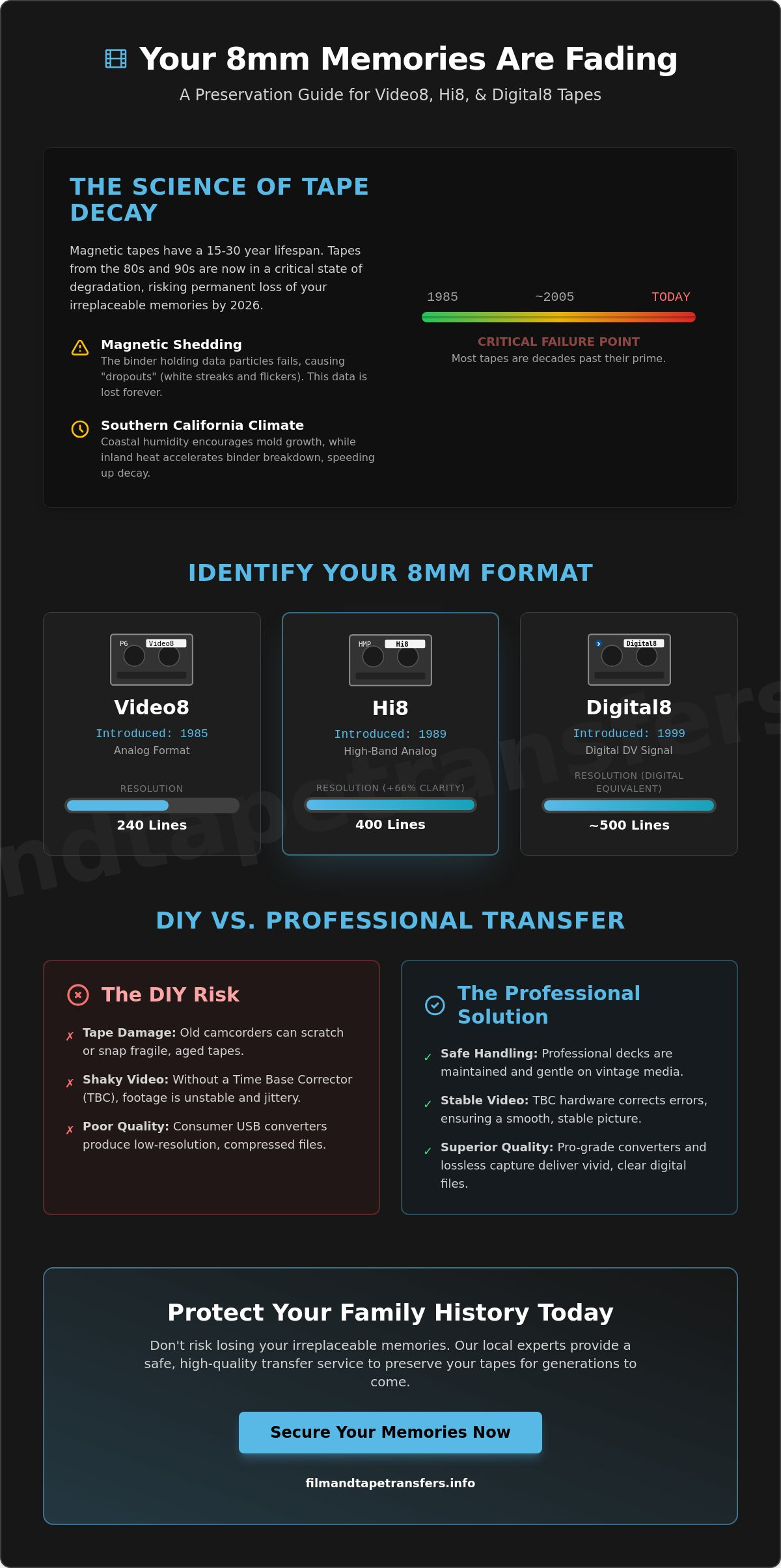
Between 1985 and 1999, the 8mm format family became the standard for home movies in Laguna Woods and across the country. Most families have a collection of these small, sturdy cassettes tucked away in closets. However, confusion is common because the physical shells are nearly identical. All three versions use a cassette measuring 95mm by 62.5mm. While they look the same on the outside, the way they record your memories is very different. Identifying your specific tape type is the essential first step for a high-quality hi8/digital8/video8 transfer.
You can identify your tapes by looking at the labels on the spine or the top of the cassette. Video8 tapes often feature a "P6" or "MP" label. Hi8 tapes usually show "HMEX" or "HMP" markings. Digital8 tapes are the easiest to spot because they almost always have the "Digital8" logo printed directly on the plastic. These markings tell us whether the signal is analog or digital. Video8 and Hi8 rely on analog waves, while Digital8 stores a digital data stream on the tape surface.
Video8 and Hi8: The Analog Powerhouses
Sony launched Video8 in 1985 to provide a compact alternative to bulky VHS tapes. It delivered 240 lines of horizontal resolution. By 1989, the format improved with the release of Hi8. This newer version increased resolution to 400 lines, which was a 66% improvement in clarity. Because these are analog formats, they are prone to signal dropouts over time. Preserving these tapes requires professional Analog-to-Digital Converters (ADC) to turn magnetic waves into modern files. We also utilize a Time Base Corrector (TBC) to stabilize the video signal. Without a TBC, old footage often appears shaky or shows jittery edges. Reviewing the history of 8mm video formats shows how these technical standards changed the way we captured family history.
Digital8: The Transition to Modern Media
Digital8 arrived in 1999 as a bridge to the digital age. It uses the same physical tape as its predecessors but records a digital DV signal. This allows for a 1:1 bitstream capture, meaning the digital file is an exact copy of the data on the tape. Compatibility is a major factor with this format. Many people assume any 8mm camcorder can play any 8mm tape. This isn't true. While some Digital8 cameras can play back analog Video8 and Hi8 tapes, about 40% of budget models lack this feature. We maintain a library of professional decks to ensure every hi8/digital8/video8 transfer is handled correctly. Using FireWire connections allows us to extract the data without any loss in quality, preserving your memories exactly as they were recorded.
The Science of Tape Decay: Why Your South Orange County Tapes Are at Risk
Magnetic tapes like Hi8 and Video8 weren't designed to last forever. Industry data confirms that these formats have a functional lifespan of roughly 20 to 30 years. Because most local families recorded their milestones between 1985 and 2005, these tapes are now reaching a critical point of failure. By 2026, a significant portion of home movies stored on magnetic media will face permanent data loss as the chemical components begin to fail.
Many people try to "test" their tapes using an old camcorder found in a closet. This is a mistake. A dirty playback head can scratch the thin magnetic coating or even snap the fragile ribbon. If the tape has started to degrade, the mechanical stress of a standard player often causes more harm than good. Professional equipment and a controlled environment are necessary for a safe hi8/digital8/video8 transfer to ensure the footage is captured before the physical media fails.
Magnetic Shedding and Oxide Loss
The chemical binder that holds magnetic particles to the plastic tape base eventually loses its stability. When this happens, the oxide layer begins to flake off, a process known as shedding. On your television, this appears as white streaks, flickering, or "dropouts" that obscure the image. Once the oxide is gone, the information is lost forever. Professional cleaning and stabilization are required to ensure the tape doesn't gum up the playback machinery during the hi8/digital8/video8 transfer process.
Environmental Factors in South Orange County
Our local Southern California climate creates unique challenges for media preservation. In coastal cities like Dana Point, humidity levels can regularly fluctuate between 60% and 80%. This moisture encourages mold and mildew to grow inside the cassette housing, which can eat through the magnetic layer. Conversely, tapes stored in Mission Viejo garages or attics face extreme heat. Temperatures in these spaces often exceed 105 degrees Fahrenheit, causing the tape layers to fuse together. This condition, often called "Sticky Shed Syndrome," makes the tape unplayable without specialized treatment.
To halt further degradation, move your collection to a cool, dry area inside your home. Store tapes vertically to prevent the reels from sagging over time. If you see white spots through the cassette window, it's time to find a trusted professional to preserve your memories before the damage becomes irreversible. Taking action now ensures your family history remains intact for future generations.
DIY vs. Professional Transfer: Choosing the Right Path for Your History
Many families start their hi8/digital8/video8 transfer project by purchasing a $20 USB adapter from a major online retailer. These "EasyCap" devices promise a quick fix for digitizing old tapes. However, the reality of DIY conversion often involves technical hurdles that can compromise the quality of your personal history. Professional transfers utilize broadcast-grade decks and time-base correctors that provide a level of stability consumer hardware cannot match.
DIY projects carry significant hidden costs. You must own a functional camcorder or a dedicated playback deck. In 2024, used Hi8 camcorders in working condition often sell for $150 to $350 on secondary markets. These vintage machines frequently suffer from degraded capacitors or worn drive belts. You might spend more money fixing a used player than you would on a professional service. Troubleshooting software drivers and computer compatibility also consumes dozens of hours that most people would rather spend enjoying their footage.
We believe in a "one-and-done" philosophy. Magnetic tape is fragile. Every time a tape passes over a playback head, it experiences physical friction. Doing the transfer correctly the first time prevents unnecessary wear and ensures you don't have to risk the media again. A professional hi8/digital8/video8 transfer captures the highest possible signal quality from the start.
The Limitations of Consumer Hardware
Cheap USB converters often fail to capture "interlaced" video correctly. Standard definition video consists of two fields that combine to create a single frame. Low-end hardware frequently discards one of these fields. This results in a 50 percent loss of vertical detail, leaving your video looking jagged and blurry. You may also experience audio drift. This is a common glitch where voices no longer match lip movements after the first 15 minutes of a capture.
- Signal Integrity: Professional setups use S-Video cables to keep color and brightness signals separate, preventing "color bleed."
- Stable Playback: Industrial decks use internal stabilizers to fix "shaky" video caused by old, stretched tape.
- Audio Quality: We use balanced audio inputs to eliminate the background hum often found in cheap USB sticks.
The Value of Professional Oversight
At Film & Tape Transfer, we don't just hit a button and walk away. Our technicians monitor every minute of your vhs to digital transfer and camcorder tape conversion. We watch for tracking errors and adjust the equipment in real-time to get the clearest image. This hands-on approach is essential for tapes that have been stored in the varying humidity of South Orange County for 30 years.
Post-transfer processing adds another layer of value. We apply subtle brightness correction and digital noise reduction to clean up the graininess common in 8mm formats. This provides peace of mind for Laguna Woods residents. You get a high-quality digital file that is ready for modern 4K televisions, backed by the expertise of a local specialist who understands the weight of your memories.
How to Prepare Your Tapes for Digitization in South Orange County
Preparing your collection properly ensures the highest quality results for your hi8/digital8/video8 transfer. By 2026, many of these magnetic tapes have reached a critical age where the physical binder begins to break down. Taking a few proactive steps helps preserve the integrity of your footage during the conversion process. Follow these four steps to get your media ready for our Laguna Woods specialists.
- Step 1: Inspect for Damage or Mold. Look for white, powdery spots on the edges of the tape spool. This is mold. Do not attempt to play these tapes in a standard camcorder, as the spores can ruin the playback heads and spread to other media.
- Step 2: Organize Chronologically. Use a pencil or removable sticky notes to number your tapes. If you know the dates or events, write them down. This organization helps us create a structured digital filing system for your family.
- Step 3: Select Your Digital Format. Determine if you want your files delivered via the Cloud, on a USB flash drive, or both. Different formats serve different purposes for long term preservation.
- Step 4: Schedule Your Drop-off. Visit our local office in Laguna Woods. Personal handling is the best way to ensure your irreplaceable memories never leave safe hands.
Choosing Your Digital Output
MP4 is the universal standard for modern media. These files work seamlessly on smartphones, tablets, and smart TVs, making them perfect for sharing on social media. For families with members living outside of Orange County, Cloud storage allows for instant access and downloads from any location. We also suggest keeping a secondary copy on a USB drive. A physical backup provides an extra layer of security against accidental Cloud deletion or internet outages.
Local Drop-off Benefits for Irvine and Mission Viejo Residents
Hand-delivering your tapes to a professional in Laguna Woods eliminates the anxiety of shipping. National carriers handle thousands of packages daily, and the risk of loss or heat damage during transit is a real concern. Local residents in Aliso Viejo and San Clemente benefit from direct consultations. You can speak with a technician about specific "problem" tapes that may require extra care. Most local projects are completed within 14 days, providing a much faster turnaround than mail-in factories.
Professional 8mm Tape Conversion: The Film and Tape Transfers Advantage
Since 1990, Film and Tape Transfers has focused on one clear mission: preserving memories for families throughout South Orange County. We know these tapes hold more than just video. They contain the specific sounds and sights of your personal history. Our lab uses technical precision to ensure every hi8/digital8/video8 transfer meets professional standards. We don't just run a machine. We monitor the signal to ensure the best possible playback from your 20 or 30-year-old media.
Our team handles a wide variety of legacy formats with the same level of care. This includes professional vhs-c transfer for those smaller camcorder tapes and high-quality minidv transfer for digital-era recordings. We maintain a library of well-maintained playback equipment to prevent the head clogs or tape eating common with old home players. Your hi8/digital8/video8 transfer project benefits from 34 years of hands-on experience in the media conversion industry.
A Trusted Guardian of Your Family Legacy
We use a white glove handling process for every fragile tape that enters our facility. This involves a physical inspection of the tape housing and the magnetic ribbon itself. We look for signs of "sticky shed syndrome" or environmental damage before processing begins. We treat every tape as if it were our own family history because we understand these moments are irreplaceable. Our commitment to using high-bitrate capture and professional signal stabilization defines our archival standard as the benchmark for local quality in Southern California.
Serving Our Neighbors in Laguna Woods and Beyond
Our location is easy to reach for residents of Dana Point, San Clemente, and Laguna Hills. We enjoy meeting our neighbors and hearing the stories behind the tapes they bring us. If you can't make it to the studio, we offer a free shipping incentive for orders over $199 within the state of California. This makes it easy to clear out your closet and protect your legacy without leaving your house.
Don't let your memories fade to static or become lost to time. Magnetic tape has a limited lifespan, and every year of storage increases the risk of data loss. Take the first step in your preservation journey today. Contact us to discuss your project or drop off your collection at our local office. We are ready to help you see your family's favorite moments again in a modern, digital format.
Secure Your Family Legacy in Laguna Woods
Magnetic tapes are physically fragile and lose data every year they sit in a closet. Your Video8, Hi8, and Digital8 recordings from the 1990s are likely nearing the end of their shelf life. Attempting a DIY transfer often results in dropped frames or poor color balance because consumer-grade players can't handle tape tension issues. Professional conversion solves these problems by using specialized broadcast-grade TBC equipment to stabilize the signal and restore visual clarity.
Film and Tape Transfers has been a trusted local South Orange County expert since 1990. We've helped thousands of local families successfully navigate the hi8/digital8/video8 transfer process with technical precision. Our team understands that these aren't just plastic shells; they're your irreplaceable family history. Don't let time erase the voices and faces of your loved ones. We're here to ensure your footage stays vibrant for another forty years.
Preserve your South Orange County memories; start your Hi8 transfer today!
Your past is worth saving for the generations to come.
Frequently Asked Questions
Can you play Hi8 tapes in a Digital8 camcorder for transfer?
Yes, most Digital8 camcorders can play your analog Hi8 and Video8 tapes for transfer purposes. Sony designed approximately 60% of their Digital8 models with backward compatibility to read analog signals. This feature allows the camcorder to convert the analog footage into a digital stream via a FireWire connection. We utilize these high-end, compatible decks to ensure a stable hi8/digital8/video8 transfer for every archive project.
How long do Hi8 and Video8 tapes last before they become unplayable?
Magnetic tapes generally have a functional lifespan of 10 to 25 years before the signal begins to fade. By 2026, many tapes recorded in the early 1990s have already passed the 30 year mark, making them high risks for data loss. Issues like "sticky shed syndrome" or magnetic particles flaking off the plastic backing are common in older media. It's vital to preserve these recordings now before the physical material degrades further.
What is the best digital format for my old 8mm camcorder tapes?
The MP4 format using the H.264 codec is the industry standard and the best choice for most families. It provides a balance of high visual quality and manageable file sizes, ensuring compatibility with 99% of modern smart TVs and computers. You can easily store dozens of hours of video on a single 128GB thumb drive. This format makes it simple to share your memories with relatives through cloud storage or social media.
Do I need to clean my tapes if I see white mold on the reels?
Yes, you must have your tapes professionally cleaned if you notice white mold spots or fuzzy growth on the tape edges. Mold is a fungus that consumes the organic binders in the tape and can ruin a camcorder's playback heads in under 5 seconds. We use specialized vacuum systems to remove spores without scratching the delicate magnetic layer. Don't attempt to play a moldy tape, as it often leads to permanent physical damage.
How much video can fit on a single Hi8 or Digital8 tape?
A standard Hi8 tape typically holds 60 minutes of footage in Standard Play (SP) mode or 120 minutes in Long Play (LP) mode. Digital8 recordings use the tape 1.5 times faster than analog formats, so a 120-minute Hi8 tape only provides 60 minutes of digital recording time. Our team monitors the exact duration of every hi8/digital8/video8 transfer to ensure every minute of your family history is captured and digitized.
Can you transfer tapes that have been sitting in a hot garage in Mission Viejo?
Yes, we can often recover footage from tapes stored in high-heat environments like local garages. Storage units in Mission Viejo can reach internal temperatures of 110 degrees Fahrenheit, which causes the tape layers to stick together or "weld." We use a 24 hour thermal stabilization process to gently treat heat-damaged media before playback. This specialized "baking" helps the tape move smoothly through our professional decks without tearing.
Why is my 8mm tape showing blue screen or static when I try to play it?
A blue screen or heavy static usually indicates that your player isn't detecting a consistent video signal from the tape. This occurs when the magnetic particles have weakened over 30 years or when the playback heads are clogged with microscopic debris. It can also happen if the tape was originally recorded in a different television standard. We use professional Time Base Correctors (TBC) to stabilize these weak signals and produce a clear image.
How do I get my tapes to your Laguna Woods studio for processing?
You can bring your media directly to our Laguna Woods studio for a safe, in-person handoff. Our office is located near the intersection of El Toro Road and Moulton Parkway, and we've served the local community for over 15 years. If you can't visit us in person, we provide secure shipping labels with tracking so you can monitor your package. We treat every tape as a trusted guardian of your personal history.