


How to Digitize Home Movies in San Clemente: The 2026 Preservation Guide
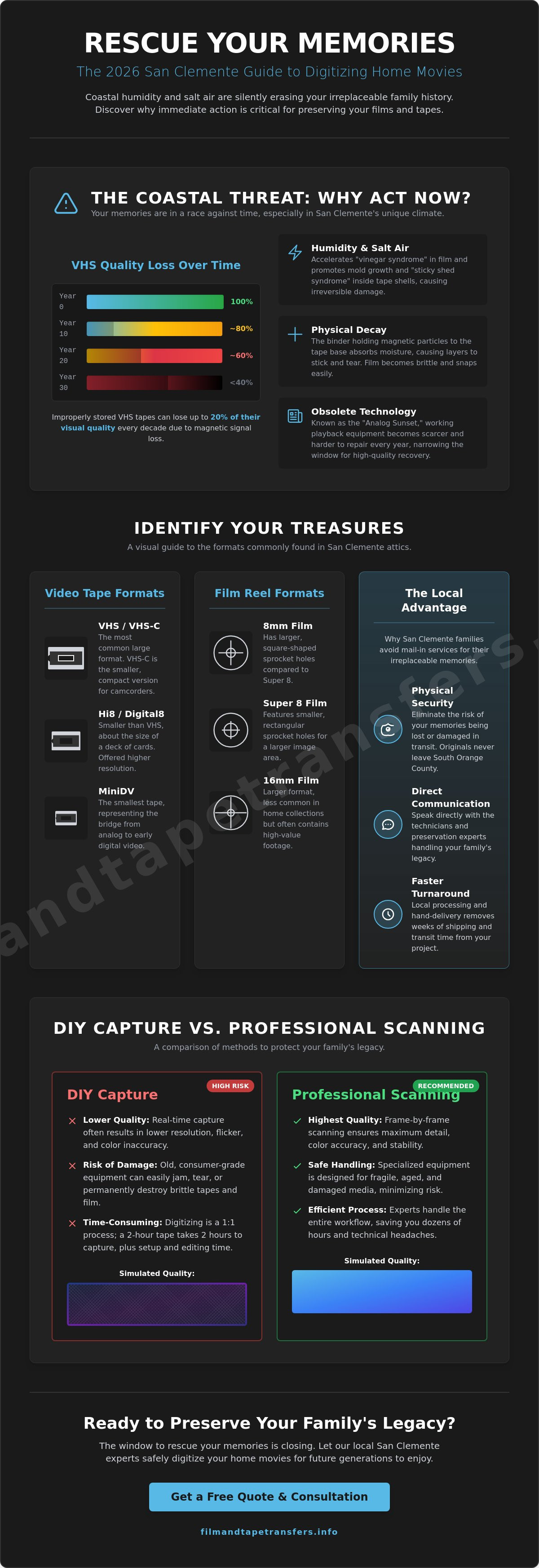
Did you know that improperly stored VHS tapes can lose up to 20% of their visual quality every single decade? For families living along the coast, the risk is even more urgent. The salt air and persistent humidity of our region accelerate "vinegar syndrome" and tape rot, slowly erasing the irreplaceable footage of your wedding or a child’s first steps. It’s exactly why so many neighbors are searching for a safe way to digitize home movies San Clemente families can rely on without the stress of mailing precious originals across the country.
We understand that these tapes and slides aren't just media; they are your personal history. You've likely felt the frustration of finding an old box of 8mm film and realizing you no longer have a working projector to see what's inside. This 2026 guide provides the clear, local steps you need to rescue your archives from environmental decay. We'll show you how to identify your specific formats and convert them into high-quality digital files that your family can enjoy for generations to come.
Key Takeaways
- Understand how San Clemente's coastal humidity accelerates the degradation of magnetic tapes and film reels.
- Learn to identify common media formats in your collection, from legacy VHS and MiniDV to 8mm and Super 8 film.
- Discover the safest local methods to digitize home movies San Clemente families use to avoid the risks of shipping irreplaceable memories.
- Compare the quality differences between DIY capture and professional frame-by-frame scanning to protect your family's legacy.
- Get a step-by-step workflow for organizing your media to ensure a seamless and cost-effective conservation process.
The Urgency of Digitizing Home Movies in San Clemente
Digitization is a critical rescue mission for your family’s past. Technically, it is the process of converting analog signals from physical media into stable binary data. Without this conversion, your history remains trapped on formats that are actively fading. Experts refer to this as the "Analog Sunset." Every year, magnetic tapes lose a portion of their signal strength. By 2026, many VHS tapes have already exceeded their 10 to 30 year functional lifespan. If you intend to digitize home movies San Clemente offers a specific set of environmental risks that make delay dangerous.
Understanding Media Decay in Coastal California
Living near the Pacific Ocean brings beauty, but the salt air and humidity are relentless. These conditions create a perfect environment for mold and mildew growth inside tape shells. We frequently encounter "sticky shed syndrome" in South Orange County collections. This occurs when the binder holding magnetic particles to the tape base absorbs moisture. Attempting to play these tapes can cause the layers to stick and tear. The Urgency of Film Preservation is especially apparent with 8mm or Super 8 reels stored in local attics or garages. Without strict climate control, the film base becomes brittle and snaps easily. Even if the physical tape appears intact, decades of storage can lead to magnetic field interference, causing ghosting and audio echoes.
The Benefits of Local San Clemente Media Transfer
Local media conservation provides essential security that mail-in services cannot provide. When you digitize home movies San Clemente families often fear losing irreplaceable footage in transit. By choosing a local professional, you eliminate the risk of shipping loss. You hand your memories directly to a technician who understands their weight. Local service ensures a high level of care and accountability.
- Direct Communication: You speak directly with the experts handling your legacy.
- Faster Turnaround: Local processing removes weeks of shipping time.
- Physical Security: Your originals never leave the safety of South Orange County.
- Specialized Knowledge: Local experts understand how to treat mold and humidity damage common to coastal homes.
The 2026 perspective is clear. As playback equipment becomes increasingly scarce and repair parts disappear, the window for high-quality recovery is narrowing. Taking action now ensures that your children and grandchildren can experience these moments with clarity. Preservation is not just about technology; it is about protecting the stories that define your family.
Identifying Your Media: What's in Your San Clemente Attic?
Before you can digitize home movies San Clemente collections require a thorough inventory. In 2026, most South Orange County households possess a mix of consumer-grade formats and professional-grade reels. Identifying these accurately ensures the correct equipment is used for the transfer. You don't need a working player to figure out what's in your box. Visual cues like tape size, reel diameter, and sprocket patterns tell the whole story. Knowing exactly what you have is the first step toward a successful preservation project.
Video Tape Formats: VHS, Hi8, and MiniDV
VHS is the most recognizable format. It is the large, black cassette that defined home theater for decades. Many San Clemente families also find smaller VHS-C tapes. These were used in compact camcorders and typically required a motorized adapter to play in a standard VCR. If your tapes are about the size of a deck of cards, they are likely from the Hi8, Digital8, or Video8 family. These 8mm magnetic tapes offered higher resolution than standard VHS. MiniDV tapes are even smaller. They represent the bridge between analog and early digital video, often containing high-quality footage that's easier to recover if the tape hasn't degraded.
Film Reels: 8mm, Super 8, and 16mm
Film reels require a different level of care. You can distinguish 8mm from Super 8 by looking at the sprocket holes. Standard 8mm has larger holes, while Super 8 has smaller, rectangular holes that allow for a larger image area. 16mm film is less common in home archives but often contains high-value family history or professional footage. Because these materials are fragile, following the Library of Congress guidelines for proper storage is vital before you start the transfer. For those with extensive collections of smaller reels, our guide on 8mm film scanning provides deeper technical insights.
Still Media: 35mm Slides and Physical Photos
Still media is just as important as video. 35mm slides were the gold standard for travel photos and family gatherings in the 1960s and 70s. These require high-resolution scanning to look clear on modern 4K screens. Physical color prints from the 70s and 80s are particularly prone to "fading," where the chemical dyes break down and shift toward a magenta or yellow hue. If you have boxes of these memories, a professional slide scanning service can restore the original color balance. Organizing your collection by format is the best way to prepare. If you're unsure what you have, local experts can help identify your media during a consultation.
DIY vs. Professional Digitization in San Clemente
Choosing between a home setup and a professional lab is a common crossroads. While the initial price of a USB dongle seems low, the total cost of ownership tells a different story. To digitize home movies San Clemente residents must factor in the price of reliable playback decks and the immense time commitment required. A typical box of twenty VHS tapes requires at least forty hours of active monitoring. DIY methods rely on real-time capture. This means if the tape plays for two hours, you must sit with it for two hours. Professionals use specialized equipment that handles the labor while ensuring the highest possible fidelity.
The Pitfalls of Consumer USB Converters
Most inexpensive USB converters lack a Time Base Correction (TBC) circuit. Without TBC, the digital file often suffers from "dropped frames" or shaky images. You might notice the audio drifting out of sync with the video as the tape progresses. These consumer devices frequently compress the video signal too early. This results in a final file with lower resolution and more digital artifacts than the original analog tape. If your goal is a true archival copy, these budget tools often fall short of preserving the original quality.
Professional Archival Standards
The difference is most visible with film. While DIY setups often involve filming a projection on a wall, professional labs use frame-by-frame scanning. This process captures every individual image on an 8mm or Super 8 reel as a high-definition photograph. The images are then reassembled into a flicker-free video. Professional services also include digital noise reduction and color correction. This restores the vibrancy that time has stripped away. Every reel or tape undergoes professional cleaning before it ever touches a scanner. This removes the coastal dust and debris that could scratch the delicate emulsion during playback.
Experience matters because of the "one-shot" rule. Aging magnetic tape and brittle film are fragile. A consumer-grade VCR can easily "eat" a tape, snapping the ribbon and ruining the footage forever. Professionals have the specialized tools and splices needed to repair damaged media safely. When you decide to digitize home movies San Clemente experts provide a level of security that a home office setup simply cannot match. You aren't just paying for a digital file. You're paying for the peace of mind that your history is being handled by a careful steward of the past.
Step-by-Step: How to Prepare Your Movies for Transfer
Organizing a large collection of family archives can feel overwhelming. A structured approach ensures that your most important memories receive priority. When you prepare to digitize home movies San Clemente families often find that a little upfront effort saves significant time and cost during the professional transfer process. Follow this simple workflow to get your media ready for conservation.
Step 1: Inventory and Sort
Begin by grouping your items by media type. Place all VHS together, film reels in another stack, and slides in their own section. This helps your technician assess the project quickly. While sorting, perform a visual check for physical damage. Look for white powder on the edges of tape reels. This is a sign of mold, which is common in our coastal climate. You should also verify the content. Tapes with handwritten labels like "Wedding 1994" are high priority. Commercial movies or recorded TV shows can usually be set aside to reduce your project volume.
Step 2: Labeling for Legacy
Maintain the original context of your media. If a tape has a faded label, don't remove it. These original notes often contain vital dates and names. Use sticky notes or a soft pencil to add your own labels to the boxes. Avoid using ink pens or markers directly on the media. Ink can bleed or smudge over time. We recommend a simple numbering system. Label your items 001, 002, and so on. This sequence allows you to match your physical items to the final digital file directory easily. It makes sharing specific clips with family members much simpler later on.
Step 3: Local Drop-off Logistics
Choosing a local service provides a level of security that shipping cannot match. Hand-delivering your collection in the San Clemente area ensures your originals never enter a high-volume sorting facility or risk being lost in the mail. When you're ready for a vhs to digital transfer, come prepared with a few questions. Ask about the turnaround time and the types of digital files provided. A professional consultation is the best time to discuss specific concerns like color correction or tape repair. If you're ready to begin the process, schedule your local media drop-off today to secure your family's history.
Choosing Film and Tape Transfers for Your San Clemente Project
Your family’s legacy deserves more than a generic transfer service. With over 30 years of local experience, Film and Tape Transfers has become the steady choice for South Orange County families. We apply a "white glove" approach to every project. This means we treat each 8mm reel and VHS cassette as an irreplaceable piece of history. When you choose to digitize home movies San Clemente residents receive the benefit of three decades of technical expertise. We focus on archival-quality results that exceed standard consumer expectations.
Our process involves more than just pressing "play." We utilize professional-grade playback decks and high-resolution scanners to capture every detail. This technical authority ensures that your wedding footage or holiday gatherings are preserved with the clarity they deserve. We understand the weight of the materials we handle. Every tape and slide is inspected and cleaned before the transfer begins. This meticulous care is what sets our local service apart from mass-market alternatives.
Our Local San Clemente Service Advantage
We serve families across the coastal corridor, from Dana Point down to San Clemente. Our local model eliminates the need for shipping. You never have to worry about your memories sitting in a distant warehouse or being lost in transit. Instead, you maintain direct communication with the technician handling your media. This transparency ensures that your specific instructions are followed. Keeping your memories close to home is the best way to ensure their safety and your peace of mind.
The Final Result: Sharing Memories in 2026
The goal of digitization is to make your history accessible again. In 2026, digital files provide the ultimate flexibility for modern families. Once your media is converted, you can easily share clips via social media or email. We provide several delivery options to fit your needs:
- USB Flash Drives: Highly portable and compatible with most smart TVs and computers.
- Cloud Storage: Convenient for instant sharing with relatives across the globe.
- Archival DVDs: A reliable format for those who prefer a physical disc backup.
We emphasize the importance of redundancy. Having multiple digital backups ensures that a single hardware failure won't erase your history. By moving your archives into the digital space, you are securing them against the physical risks of coastal living. It is time to bring those box-bound memories back to life. Contact Film and Tape Transfers today to preserve your San Clemente legacy and ensure your family's stories are never forgotten.
Secure Your Family Legacy Today
Deciding to digitize home movies San Clemente families have kept in storage is the most critical step in legacy conservation. You now understand how coastal salt air and humidity threaten the integrity of your magnetic tapes and film reels. Choosing professional archival-grade transfers over low-quality DIY converters ensures that your wedding and holiday memories are captured with the highest possible fidelity. A structured inventory and careful labeling process will help you prioritize your most precious clips for rescue.
Since 1990, we've served South Orange County as a dedicated steward of personal history. Our specialized focus on archival-grade 8mm and VHS transfers provides the precision your irreplaceable media requires. With local drop-off available for San Clemente residents, you can rest easy knowing your originals remain safe and close to home. It's time to move your archives out of the dark and into the modern digital era.
Start Your San Clemente Home Movie Transfer Today. Your family's stories are far too valuable to lose to time or environmental decay. We're ready to help you preserve them for generations to come.
Frequently Asked Questions
Is it better to get my home movies on DVD or a USB drive?
A USB drive is the superior choice for most families in 2026. While DVDs offer a familiar physical disc, they are easily scratched and require a dedicated player. USB drives provide high-definition files that are easy to copy, edit, and play on almost any modern computer or smart TV. This format ensures your memories remain accessible as technology continues to evolve.
Can you digitize home movies that have mold on the tapes?
Yes, we can often rescue media with mold damage. When you digitize home movies San Clemente collections frequently show signs of white powder on the tape edges due to coastal humidity. These tapes require a specialized cleaning process before the transfer to protect the footage and our equipment. It is vital to handle these tapes carefully and avoid playing them in a home VCR, which can cause the delicate ribbon to snap.
How much does it cost to digitize home movies in San Clemente?
The total investment depends on the volume of your collection and the specific formats involved. Professional services are priced based on the labor required for cleaning, the type of high-resolution scanning used, and the final delivery format. We provide a clear estimate after a physical evaluation of your tapes and film reels. This ensures you only pay for the successful preservation of your specific memories.
How long does the digitization process typically take?
Most projects are completed within two to four weeks. This schedule allows our technicians enough time to perform thorough cleaning, frame-by-frame scanning, and color correction. Larger archives or tapes requiring significant repair may take longer. We prioritize quality and precision over speed to ensure every frame of your family history is preserved correctly.
What happens if my 8mm film reel is broken or snapped?
Broken or snapped film is a common issue with aging 8mm and Super 8 reels. Our technicians use professional splicing equipment to reconnect the film safely. These repairs are performed with archival-grade materials that won't damage the film during the scanning process. Once spliced, the film can move smoothly through our high-definition scanners for a seamless digital result.
Can I watch my digitized movies on my smart TV or iPhone?
You can view your digitized movies on almost any modern device. We provide files in the MP4 format, which is the industry standard for compatibility. You can plug a USB drive directly into your smart TV or upload the files to a cloud service to watch them on your iPhone or tablet. This makes sharing favorite moments with relatives across the country simple and fast.
Do I get my original tapes and film reels back after the transfer?
We return all original media to you once the digitization project is finished. Your physical tapes, film reels, and slides are irreplaceable family heirlooms. We handle them with the utmost care throughout the process and return them in the same organized state you provided. Many families choose to keep the originals in a climate-controlled environment as a secondary physical backup.
What is the best way to store my new digital files for the long term?
The most reliable strategy is the 3-2-1 backup method. Keep three separate copies of your digital files on at least two different types of media, such as a USB drive and a computer hard drive. Store one copy off-site using a secure cloud service. This approach protects your legacy against hardware failure, accidental deletion, or local environmental disasters.