


Professional Super 8 Film to Digital in Dana Point: Preserving Your Legacy
You pull a yellow Kodak box from the back of a Dana Point closet and catch a faint, vinegar-like scent. It's a 3-inch reel of a family sunset at Salt Creek from 1972, but the film feels brittle to the touch. You know these memories are priceless, yet the fear of mailing your only copy to a massive lab keeps your Super 8 film to digital Dana Point project on hold. It's a common worry, and you deserve a solution that prioritizes the safety of your physical media while delivering modern, high-definition results.
Local preservation experts offer a reliable way to bridge the gap between aging celluloid and today's technology. By choosing a specialized service, you can safely convert your legacy into high-definition files playable on any modern TV or smartphone. This article explains the benefits of frame-by-frame scanning, how to prevent permanent loss from Vinegar Syndrome, and why local handling is the gold standard for film conservation. You'll discover exactly how to transform those dusty boxes into a digital library that your family will cherish for generations to come.
Key Takeaways
- Understand how Dana Point’s coastal humidity accelerates film degradation and how to identify early warning signs like Vinegar Syndrome.
- Discover why modern frame-by-frame scanning is superior to outdated telecine methods for creating stable, flicker-free digital files.
- Learn to identify standard Super 8 reel sizes and formats to accurately estimate your footage length and project scope.
- Find out why choosing a local expert for Super 8 film to digital Dana Point ensures your irreplaceable memories are never lost in the mail.
- Get practical tips for organizing and inspecting your film collection to ensure a seamless and high-quality preservation process.
Why Super 8 Film to Digital is Critical for Dana Point Families
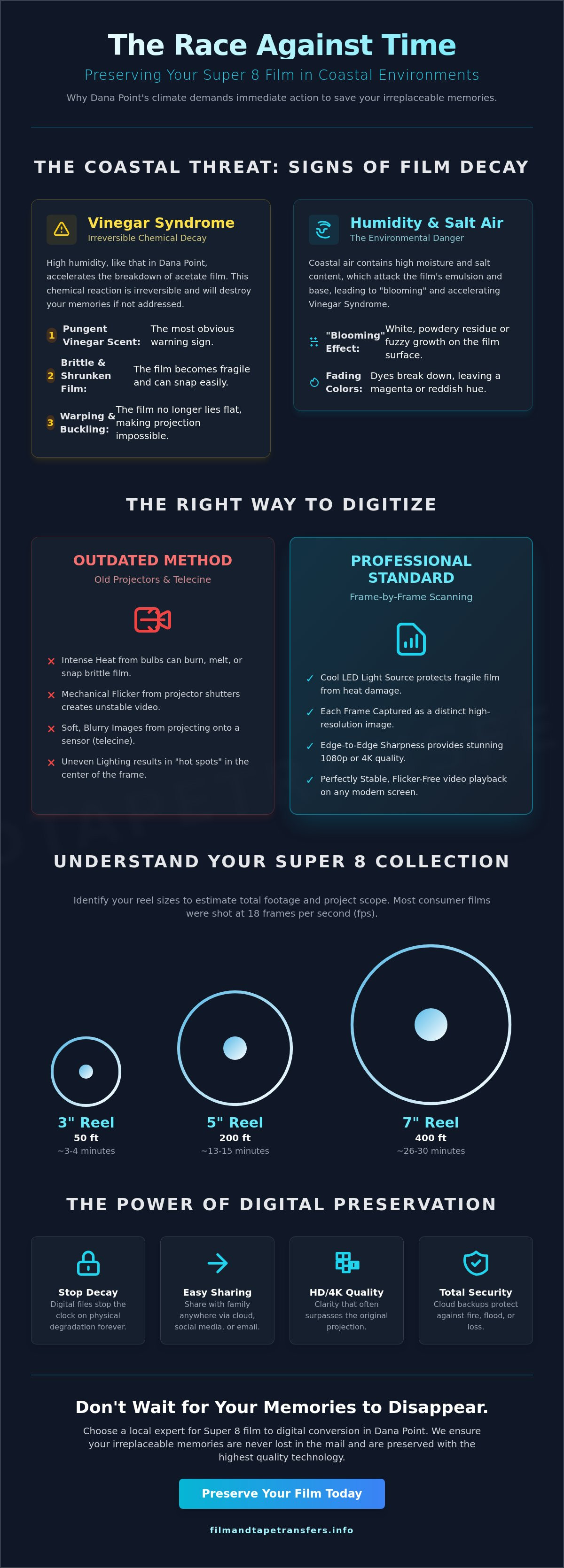
Super 8 film captured the spirit of a generation. From 1965 through the late 1980s, the Super 8 film format served as the primary medium for recording backyard barbecues and coastal vacations. For families in Dana Point, these reels often hold footage of the harbor's early days or long-gone local landmarks. However, the very environment that makes our city beautiful also threatens these memories. Coastal humidity and salt air accelerate the breakdown of acetate film bases, making the transition from Super 8 film to digital Dana Point a race against time.
Digitization does more than just modernize your media; it stops the clock on physical decay. Once a reel is converted, the colors and clarity are locked in place forever. You no longer have to worry about the dyes fading or the film becoming too brittle to handle. Modern digital files are versatile. You can store them on a USB drive, upload them to the cloud, or share them instantly with relatives across the country through social media. This accessibility ensures that your family's history isn't trapped in a dark closet, but is instead part of your daily digital life.
The Threat of Vinegar Syndrome in Coastal Environments
If you open a film canister and notice a sharp, pungent odor, your memories are in danger. This scent indicates the onset of Vinegar Syndrome, which is the irreversible decay of cellulose acetate film. In Dana Point, the high moisture content in the air speeds up this chemical reaction. You might also notice "blooming" on the film surface. This is a white, powdery residue or fuzzy growth caused by salt air and humidity. Once this process begins, the film can warp, shrink, and eventually become unplayable. Acting quickly to secure a professional transfer is the only way to save the footage before the image layer separates from the base.
Modern Viewing vs. Projector Risks
Dusting off an old projector might seem like a nostalgic idea, but it's often a mistake. Old equipment generates significant heat. Brittle film can snap or melt under the intense light of a projector bulb. Professional scanning avoids these risks entirely. Modern Super 8 film to digital Dana Point services offer 1080p or even 4K resolution, often surpassing the quality of the original projection. Your family history becomes accessible on smartphones and smart TVs, ensuring the next generation can enjoy the legacy you've preserved. Some of the benefits of modern digital formats include:
- Durability: Digital files don't degrade with repeated viewings.
- Quality: High-definition scans capture details the human eye might miss on a wall projection.
- Portability: Take your entire film library with you on a single thumb drive.
- Security: Cloud backups protect your memories from fire, floods, or physical damage.
The Professional Scanning Process: Frame-by-Frame Quality
High-quality preservation is a technical craft that begins long before your film enters a scanner. Professional labs prioritize the physical integrity of your media. Every reel undergoes a thorough inspection for broken splices or damaged sprocket holes. Cleaning and lubrication follow. These steps remove decades of accumulated dust and prevent the film from snapping during the scanning process. When Preparing Your Film for Transfer, experts look for signs of chemical decay or mold. This careful handling ensures that the delicate acetate base remains intact throughout the conversion.
The machinery used for Super 8 film to digital Dana Point projects defines the clarity of the final memory. Cheap consumer converters often use "telecine" methods. These essentially record a projection of the film, which leads to flickering and soft edges. Professional-grade scanners capture each individual frame as a standalone high-resolution image. This method eliminates the mechanical flicker associated with old projectors. It produces a stable, crisp video file that looks better than the original film ever did on a beaded screen.
Frame-by-Frame vs. Real-Time Transfer
Real-time transfers often suffer from motion blur and uneven lighting. Since the film moves at a constant speed, the camera can't capture the full detail of every frame. Frame-by-frame scanning ensures edge-to-edge sharpness and perfect playback speed by treating every frame as a unique photograph. Modern scanners use cool LED light sources. Unlike the hot halogen bulbs found in old projectors, these LEDs won't burn or warp fragile film. If you have a box of memories waiting for this level of care, you can explore our local scanning services to see the difference professional equipment makes.
Restoring Color and Contrast
Old Kodachrome and Ektachrome films often develop a heavy red or yellow tint over time. This color shift is a natural part of chemical aging. Professional software allows for scene-by-scene color balancing to restore the natural look of skin tones and landscapes. Technicians can also adjust the contrast to recover details lost in dark, underexposed scenes. Professional color correction can recover details lost in dark underexposed scenes that would be invisible on a standard projector. While deep gouges are permanent, digital tools can significantly reduce the appearance of minor surface scratches. This restoration brings back the vibrancy of the original moment for your Super 8 film to digital Dana Point project.
Understanding Super 8 Reel Sizes and Formats
Identifying the contents of your collection is the first step in planning a successful Super 8 film to digital Dana Point project. Most family archives consist of a variety of plastic or metal reels stored in cardboard boxes. These reels typically come in three standard diameters, and knowing which ones you have will help you estimate the total runtime of your footage. The most common size is the 3-inch reel. These small reels were the standard for home movie cameras and hold 50 feet of film. At standard playback speeds, a single 3-inch reel provides approximately 3 minutes of captured memories.
Larger reels were often used by enthusiasts or created when families spliced multiple small reels together for longer viewing sessions. A 5-inch reel holds 200 feet of film, while the 7-inch "full" reel contains 400 feet. We deliver the final preserved files as MP4s. This format is the industry standard for a reason. MP4 files offer a perfect balance of high-definition clarity and small file sizes. They work seamlessly on modern smart TVs, tablets, and smartphones, making it easy to share your legacy with relatives near and far.
How to Identify Your Reel Footage
Measuring the diameter of your reels is the most reliable way to gauge the scope of your archive. Use this quick guide to determine your footage totals:
- 3-inch Reel: 50 feet (approx. 3 minutes)
- 5-inch Reel: 200 feet (approx. 12 to 14 minutes)
- 7-inch Reel: 400 feet (approx. 25 to 30 minutes)
It is also important to distinguish between Regular 8mm and Super 8. While both are 8mm wide, Super 8 has smaller sprocket holes and a 50% larger frame area. This allows us to capture significantly more detail during the scanning process. If you aren't sure which format is in your box, our 8mm film scanning guide provides a detailed look at the technical differences between these two legacy formats.
Transferring Super 8 Sound Film
While many home movies are silent, some Super 8 reels feature a magnetic "sound stripe." You can identify these by looking for a thin, copper-colored band running along the edge of the film opposite the sprocket holes. Capturing this audio requires specialized archival equipment that reads the magnetic track while simultaneously scanning the image. Sound film requires specific expertise because the magnetic stripe can become brittle or begin to flake off as the film ages. A professional Super 8 film to digital Dana Point service ensures that the audio remains perfectly synced with the high-definition video, preserving the voices and ambient sounds of the past alongside the images.
Preparing Your Film for Transfer in Dana Point
Preserving your legacy starts with a thoughtful audit of your collection. Organization is the foundation of a high-quality digital archive. Before you begin your Super 8 film to digital Dana Point project, set aside time to inspect each reel. Physical damage is common in older films. Check for broken splices or sprocket holes that have become brittle. You should also sniff the reels for a pungent vinegar scent. This odor indicates active chemical decay. Identifying these issues early allows technicians to apply the necessary repairs before the scanning process begins. A quick visual check ensures your films are ready for the high-resolution sensors used in modern scanners.
Selecting your delivery format is another key decision. Your choice depends on how you plan to use and share your memories. USB drives are excellent for long-term physical backups. They plug directly into most modern smart TVs and computers. Cloud downloads offer the greatest convenience. They allow you to send a link to relatives anywhere in the world immediately. For those who enjoy a tangible disc, we still offer high-quality DVD transfers. If you want to move forward with your preservation project, book your local film transfer and let our experts handle the technical details.
Chronological Sorting and Labeling
Your digital archive should tell a story. Sorting your reels chronologically is the best way to achieve this. Use masking tape or small sticky notes to number each box clearly. If you aren't sure of the exact dates, look for context clues. Original boxes often have handwritten notes about birthdays, vacations, or holidays. Even a rough sequence is better than none. We often see collections of small 50-foot reels that are difficult to manage. Our team can help consolidate these small reels onto larger, professional archival reels. This process organizes your collection and makes the final digital files much easier to navigate.
Storage Tips While You Wait
Dana Point's proximity to the ocean means that salt air and humidity are constant factors. These elements are the enemies of vintage film. Until you can bring your reels in, keep them in a climate-controlled part of your home. Never store your films in a shed, garage, or attic. These areas suffer from extreme temperature swings that cause film to expand and contract. This cycle leads to brittleness and image loss. It's helpful to store film reels vertically on a shelf rather than stacking them in a heavy pile. Vertical storage prevents the plastic or metal reels from warping and protects the delicate edges of the film strip. These simple habits ensure your Super 8 film to digital Dana Point transfer produces the clearest possible images.
Why Choose Film and Tape Transfers for Dana Point Preservation?
Trust is the most important factor when you're handing over decades of family history. We are a locally owned small business dedicated to serving Dana Point and the surrounding South Orange County communities. Unlike national chains or massive processing centers, we treat every project as a unique piece of personal history. Your irreplaceable films never leave our hands. We don't ship your reels to out-of-state labs where they risk being lost or damaged in transit. We act as careful stewards of your past, ensuring that every Super 8 film to digital Dana Point project is completed with precision and care.
Our expertise extends beyond film. We specialize in archival-grade transfers for a wide variety of legacy media. This includes everything from consumer video tapes to professional 35mm slide scanning. Our focus is always on legacy conservation. We understand that these aren't just reels of plastic; they're the only records of your family's most important milestones. We use a steady, service-oriented approach that prioritizes high quality over mass-market speed.
Local Service for South Orange County
Residents in Dana Point, San Clemente, and Laguna Woods don't need to drive to Irvine or Los Angeles for expert preservation. We provide a convenient local solution that allows for direct communication with the technician handling your media. You can ask questions and discuss your specific needs face-to-face. This level of personal service helps you avoid the risks associated with a professional VHS to digital transfer through big-box retailers. Large chain stores often act as middle-men, shipping your items to third-party facilities. We keep your memories safe and local from start to finish.
Our Commitment to Quality
We use professional-grade scanners designed to extract the maximum amount of detail from every frame. These machines offer superior resolution and color accuracy compared to the equipment used by budget services. Every Super 8 film to digital Dana Point order includes a detailed quality check. We review the final files to ensure no footage was missed and that the playback is stable. Our no-nonsense attitude toward quality means you get the best possible results for your family archive. Contact us today to schedule your local drop-off in the South OC area and take the first step toward securing your legacy.
Secure Your Family Legacy for Future Generations
Your family memories deserve better than a dusty box in a coastal closet. The combined threats of salt air humidity and chemical aging make preservation a time-sensitive priority. By choosing a professional Super 8 film to digital Dana Point service, you move your history from fragile acetate to secure digital formats. This transition ensures that your footage remains vibrant and accessible on modern devices without the risk of projector damage. Digital files are easy to share, back up, and enjoy for decades to come.
We've served South Orange County since 1990 with a focus on archival-grade results. Our expert frame-by-frame scanning captures every detail of your film with precision and care. Because we are a local business, your irreplaceable reels never leave our hands. You can enjoy the peace of mind that comes with local drop-off, and no shipping is required. There is no reason to risk your only copies in the mail. Preserve your Dana Point memories; contact us for a Super 8 transfer quote today!
Protecting your history is a rewarding project that brings the past back to life. Take the first step toward securing your family's story today.
Frequently Asked Questions
How much does it cost to transfer Super 8 film to digital?
Transfer costs depend primarily on the total footage length and the specific reel sizes in your collection. Factors such as whether the film includes sound or if you require high-definition versus 2K resolution also influence the final investment. Because every family archive is unique, we provide custom quotes based on the number of 3-inch, 5-inch, or 7-inch reels you need preserved.
Can you digitize Super 8 film that has sound?
Yes, we utilize specialized equipment to capture both the image and the magnetic sound stripe found on some Super 8 reels. Our process ensures the audio remains perfectly synced with the high-definition video during the frame-by-frame scan. This allows you to hear the original voices and background sounds exactly as they were recorded decades ago.
How long does the Super 8 to digital process take?
Most standard preservation projects are completed within two to three weeks from the time of drop-off. If you have a particularly large archive or reels that require significant repair due to Vinegar Syndrome, the timeline may be longer. We prioritize quality and careful handling over mass-market speed to ensure your legacy is preserved correctly the first time.
What is the difference between 8mm and Super 8 film?
The main difference is the size of the sprocket holes and the resulting image area. Super 8 film has much smaller sprocket holes, which allows the actual picture frame to be about 50% larger than standard 8mm. This larger frame area provides significantly better clarity and detail when we perform your Super 8 film to digital Dana Point transfer.
Is it safe to project my old Super 8 films one last time?
We strongly advise against using old projectors on vintage film that hasn't been digitized yet. Projector bulbs generate intense heat that can melt brittle acetate in seconds. Additionally, the mechanical claws in old equipment can easily rip through aged sprocket holes. It is much safer to let a professional scanner handle the film using cool LED light sources.
What digital format will my converted Super 8 films be in?
We typically deliver your memories as high-definition MP4 files because they offer the best compatibility across all modern devices. These files work perfectly on smart TVs, Mac and PC computers, and mobile phones. We can also provide other formats like MOV or AVI upon request if you plan to perform your own advanced video editing.
Do you provide services near Dana Point and San Clemente?
Yes, we are a locally owned business serving families throughout Dana Point, San Clemente, and the surrounding South Orange County area. Our local presence means you don't have to risk shipping your irreplaceable reels through the mail. You can drop off your media directly and speak with the technician who will be managing your Super 8 film to digital Dana Point project.
Can you fix broken or snapped Super 8 film?
Our technicians are experts at repairing broken splices and snapped film strips before the scanning process begins. We inspect every reel for physical integrity and replace old, failing tape splices with fresh, archival-grade joins. This preparation ensures that your film passes through the scanner safely without further damage, resulting in a seamless digital file.